Tuesday, November 14, 2017

If I Could...

In a recent pastoral visit by Bishop Dagoberto Sosa Arriaga to the parish of St. James the Apostle in Acatepec, two young indigenous women shared the following words with the bishop. I suspect that their thoughts reflect what many supporters of Mission Mexico think. Here, in English translation, is part of what they said:

Father Francisco, Bishop Dagoberto, and Father Ruben are received by the villagers of Acaptepec
The Mountain is a beautiful place, beautiful for its views, its people, its cultures. And especially beautiful because we have learned how to live despite all of the adverse circumstances that surround us. We know how to laugh and how to share with others. We are like a log on the campfire, always ready to give heat and light to those who need such. We live with a great hope in a better future, but the uncertainty, the abandonment, the extreme poverty, and the violence force us to ask ourselves if this better future is possible.

The main question is: Why? It’s a simple word that requires big answers—and a big commitment of everyone in this country.
The two young women share their reflections with the bishop
Why do our children, young people, and adults of the indigenous peoples of Mexico (and of other places in the world) have no shoes, no clothing, no food, no decent house, no higher education? Why are we poor and marginalized; why do we die of hunger and thirst? Other people walk around with shoes and clothing and with a full stomach. And some even have cars, planes, helicopters, beautiful houses. And we are made more impoverished by having to pay high fees for taxes, electricity, propane, gasoline, and basic food items.

Why do some have to die before being born, or at a very tender age? Why are there no medicines in our health centers? Why are there no doctors? Why is it that others, who speak other languages and are of a different color, have good salaries, health care, pensions, food, telephone—everything, it seems?
The cemetery in Metlatonoc on the Day of the Dead, on November 2
Why is it that others can live to 70 or 80 or 90? Why do others get to decide our salary and our future? Why are some so incredibly rich and we so miserably poor? Is this what God wants, or is it a decision made by just a few or by those who govern us? Why is there such inequality? Why are there the exploited and the exploiters? Is this what it means to be civilized or to have a conscience? We have received enough fine words. We need concrete actions! We have had enough promises, reforms, and counter-reforms—it seems that these only make us poorer.

Mexico is a rich country, with hard-working people and many natural resources. But what good does this do if our institutions, our politicians, our court system, and even international organizations do not work to see that there is a fair distribution of these goods?
Looking elderly doesn't mean that one is elderly
Why are our decisions not respected among the different institutions of our country? Why are there false promises, electoral fraud, no real democracy? The mass media sells its soul to the highest bidder. The politicians get rich from programs that are supposed to help the poor. People speak about peace, justice, love, charity, respect. Yet we native peoples experience little of that.

Everyone says that we want peace—but there can be no peace without justice, without reconciliation, without a change of attitude and conduct, without meeting the needs of the poor, without an end to repression, without the guidance of the Spirit of God.
Children from Tototepec—hopefully their future is a beautiful one
If I could—if it were in my hands—I would create a different world, where we human beings would be truly human, where there would be no misery, no hunger, no injustices, no violence, no discrimination against the indigenous peoples. A world where we would all love one another and look after one another.

If I could, I would invest in science and technology so that no would have to be hungry, and no one would lack their daily bread (and maybe there could be a little extra for an ice cream or a chocolate bar); no one would have to complain about being a peasant farmer.
There are few "extras" in the lives of the indigenous in the Mountain
If I could, I would look for ways to bring joy to the children and youth and adults, so that they could enjoy every stage of life, so that they could grow as human beings, so that they could interact with creation with joy and dignity, so that there would be no sadness or tears or misery or violence.

If I could, I would break down the walls that separate us as rich and poor, as slaves and free, as natives and non-natives. All humans would be sisters and brothers living in our common home, and there would be no borders to divide us.
Children in Yuvi Nani (long river in na savi)
If I could, I would create educational institutions that provide high-quality education to all. Parents would not have to suffer so much to educate their children; teachers would receive a decent salary.

If I could, I would build better hospitals and see that they were well-equipped and with qualified nurses and doctors. No one would be left out in terms of access to health care, and the health personnel would not discriminate in the case of indigenous patients.
Even those who are elderly have to work if they wish to eat
If I could, I would establish universities that relate to the interests and culture of the peoples. They would be designed to respond to the economic and cultural needs of the people; the goal would not just be to provide a cheap labor force for big business.

If I could, I would demand that our Mother Earth be respected, that there be more concern for the environment. I would work to bring an end to contamination and to the use of poisonous chemicals.
Candles and flowers—essentials if one is going to approach God
If I could, I would see that all reforms are planned, not from a desk in an ivory tower, but in consultation with the peoples affected by such reforms. Everyone would work together for the well-being of all.

If I could, I would work for just laws and legal institutions, where the rich can not buy decisions, where there is no impunity, where there is no corruption. The rich would not be allowed to become richer at the cost of the poor becoming poorer.
When the bishop visits, the women prepare food for all
If I could, I would see that everyone, even the most impoverished, had a dignified home. One of the best ways for this to happen is to offer decent jobs and decent wages.

If I could, I would allow the indigenous people to follow their traditional customs of assemblies and consensus in electing their governing authorities. Political parties often divide and discriminate. Transparency, honesty, and service would be the hallmarks of those who get involved in politics.
Israel, Antonieta, and Baltazar in their school uniforms
If I could, I would work so that our Catholic Church be more committed in evangelizing and combating the structures of death in our villages. The pastoral agents should work to create missionary disciples who organize to bring and to be good news. Our priests should be spiritual guides who, by word and by example, accompany us in our daily struggles.

If I could, I would place these words in the minds and hearts of all present here today, so that we all be sensitive to the struggles of the poor and so that we all do what we can to change this situation. To do nothing is to journey toward a catastrophic and apocalyptic future. We trust in the God of Life and Divine Justice that we will all receive God’s blessing and assistance. Thank you.
Bishop Dagoberto receives a live turkey as a farewell present

Wednesday, October 4, 2017

Note from Tlachinollan to Mission Mexico


 Dear Michael MacDonald and Mission Mexico friends:


                                                          Tlapa de Comonfort, Guerrero
                                                             September 22, 2017


The storms, hurricanes, and earthquakes that have caused so much havoc in several states in the southern part of our country, such as Puebla, Morelos, Mexico City, Oaxaca, and Chiapas, have deeply wounded hundreds of families who lost loved ones as well as their most prized possession: their homes. Just in this month of September we have suffered the intensity of nature’s fury; and this is even more painful given the indifferent attitude and stubbornness of the authorities who have attempted to control even the expressions of solidarity of the many Mexican men and women who have taken to the streets to offer assistance; it is amazing to see how the Mexican people have come together to help others.

We are grateful for your concern about what is happening in our country and for your solidarity. We would like you to know that here in the Mountain, in spite of the fact that the rains continue pouring down and the earthquakes have shaken us literally and figuratively, up until now there is no loss of life to report. In the indigenous villages, many people have been on the edge of hunger since the loss of their crops in 2013; and they have been trying to rebuild their own homes, since the government failed to follow through on their reconstruction promises.

We would also like you to know that the mothers and fathers of the 43 disappeared students from the teacher’s college in Ayotzinapa face a particularly difficult time, because the latest tragedy on September 19 meant that the Mexican society has concentrated all of its efforts on rescuing the people trapped within the fallen buildings. We understand that this has to be the priority, and the mothers and fathers of the 43—in the midst of their own pain and despair for not locating their children—have changed their plans in terms of honoring the third anniversary of their children’s disappearance; they have opted to carry out actions of solidarity with the families affected by the earthquakes. This speaks of their noble hearts and of their compassion; just as they have been trying to find their loved ones for three years, their hope is that other families be able to find their loved ones in the rubble of the destroyed buildings. Their example encourages us, as does the example of so many young people who grabbed a pick and a shovel to help to remove the debris that buried hundreds of people.

We will continue to try to respond to the needs of the families of the 43 disappeared students, especially since several mothers and fathers are presently ill, and several have reported that that their homes suffered some damage during the recent quakes.

Receive a fraternal embrace from all of us here at the Tlachinollan Human Rights Center of the Mountain.

  
Abel Barrera
      Director


Calle Francisco Javier Mina No. 77 Colonia Centro, Tlapa de Comonfort, Guerrero. C.P. 41304. 
Teléfono + 52 (747) 47 6 12 00. 
Email: cdhm@tlachinollan.org

Thursday, September 21, 2017

Earthquakes in Mexico—September 2017

Some of the destruction in Mexico City—and the volunteers assisting
I am sure that anyone who reads a newspaper or who watches television in Canada is now quite aware of the terrible earthquakes—one on Sept 7, and another on September 19—that have caused loss of life and major destruction in several parts of Mexico. The earthquake on September 7 affected mostly the states of Oaxaca and Chiapas; the earthquake on September 19 affected mostly the states of Morelos and Puebla and Mexico City.
Many residences (and schools and work places) will have to be torn down completely
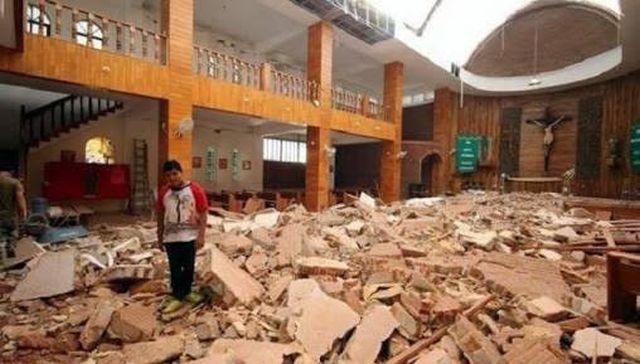
I am writing this short blog simply to let people know that I and my friends here in the Mountain of Guerrero are fine. We definitely felt the two earthquakes, but there was no loss of human life, such as occurred in other places. Many buildings were damaged, some severely—for example, the church in Xochihuehuetlan was so severely damaged that it will have to be totally demolished.
The parish church of St. James the Apostle, in Xochihuehuetlan—before the earthquake
But some close friends of Mission Mexico have now had their lives turned around because of these earthquakes. In Cuernavaca Paty Gasca and Rodrigo Cruz lost the apartment that they had bought a few years ago. There is not a culture of “house insurance” in Mexico like there is in Canada, so a family often has to continue paying the mortgage on the destroyed property while at the same time trying to find a new place to live. You, the reader, may remember that Paty, a graphic designer, has assisted with many publications for Mission Mexico and has coordinated projects in the State of Morelos; Rodrigo, a professional photographer, has supplied Mission Mexico with many incredible images of life here in the mountains of Mexico. 
Paty and Rodrigo—grateful to be alive
And a good friend in Mexico City, Veronica Aguilar, lost the house in which she lived with her mother. Veronica was here in the mountains in the month of February with a dental brigade offering free service in the impoverished village of Agua Tordillo.
Veronica and her mom now have to try to put life together again
At the present time, there is a lot of havoc and confusion in the areas affected. Later, the task of rebuilding will take place. Here in Tlapa, many groups are collecting food, water, medicines, clothing, blankets, etc., to bring to the areas most affected. It is quite amazing to see the solidarity of the Mexican people—and it is especially amazing to see that the poorest of the poor tend to be the persons who most willingly share with others.
A barefoot woman offering food to send to the earthquake victims
Mission Mexico is trying to assist in these efforts as best it can, especially by using its truck to pick up items to be delivered to the neediest areas and by helping to pay for gasoline so that vehicles can bring the supplies that are gathered for the victims of the earthquakes. It will be a long struggle for many families to “reconstruct” their lives, but we will try to assist as best we can in these efforts.
One of many groups in Tlapa collecting supplies for the needy
To close this blog, I would like to mention a good friend of mine: Mauricio Suarez. This young man is the son of Nacho and Inés, a young Mexican couple who died in a car accident sixteen months ago. Mauricio studies law at the UNAM (National Autonomous University of Mexico) in Mexico City, and he has worked tirelessly to organize the university students to provide assistance to the neediest of the needy in isolated communities in his native State of Morelos. Mauricio is just one example of the thousands of people who are selflessly working in solidarity, and I can only imagine the pride that Inés and Nacho would have if they could be accompanying him now. 
Mauricio (in green): organizing university students to work in solidarity

Wednesday, September 13, 2017

"Help the Poor" in the Aftermath of Earthquake

(Photos for this article, showing the aftermath of the earthquake,
were downloaded from the Internet)
Help the poor.
Help poor me.
I'm in trouble, don't you see?
Only your love can save me.
Help the poor! Help the poor!
-       B.B. King

Listening to B.B. King and Eric Clapton sing the song “Help the Poor” seems appropriate during these days following Mexico’s strongest earthquake—magnitude 8.2—in a century. It occurred just before midnight on Thursday, September 7. I was lying in bed in my third-floor apartment when the shaking began. I have experienced several earthquakes in Mexico during the past thirty-five years, but this was definitely the scariest.

Mexico’s three most indigenous states—Guerrero, Oaxaca, and Chiapas—are also Mexico’s poorest states. Here in Guerrero there were landslides and blocked roads but no loss of human life and little destruction of buildings. The situation was very different in Oaxaca and Chiapas, home to about nine million people. About a hundred people were killed, thousands were injured, thousands lost their homes, and many schools and hospitals and churches and workplaces were damaged or destroyed.

For years Mission Mexico has been a partner with the Missionaries of the Holy Spirit, first in Tlapa and presently in San Marcos Xochitepec, here in the State of Guerrero. This religious congregation quickly organized an effort in Mexico City to respond to the needs of the injured and displaced people. My respect to these friends for their quick response to the crisis.

Another partner of Mission Mexico, the Champagnat High School of the Mountain, run by the Marist Brothers in Potoichan, learned that a high school also run by the Marist Brothers in Ixtaltepec, Oaxaca, was badly damaged by the earthquake. The school had to close its doors for the time being. It is too early to say when the school may be able to function again.

And Mission Mexico has heard from many of the young people who are studying university in different places in Mexico thanks to a scholarship from Mission Mexico. These students tell of classmates who now have no home to return to or who lost family members. In many places these students are organizing to assist their friends in this terrible time of need.

Other friends who have been involved in assisting the indigenous communities here in the Mountain of Guerrero were also affected by the earthquake. Just as an example, Father Eleazar Lopez Hernandez, who works with CENAMI (the National Center of Support for Indigenous Missions), now has to help his elderly parents whose home was destroyed by the earthquake. Bishop Alejo Zavala Castro, who visited Canada several times as a guest of Mission Mexico, is the vice president of the Advisory Board of CENAMI. And people involved in health and education projects from the impoverished area of Xalpitzahuac—with support from Mission Mexico—are also partners with CENAMI.


So, with so many of Mission Mexico’s friends—and friends of friends—directly affected by this terrible tragedy, B.B. King’s lyrics seem apropos. “Help the poor.” “I’m in trouble, don’t you see?” “Only your love can save me.” The Diocese of Calgary, through Mission Mexico, has been trying to share that love for the poorest of the poor for almost twenty years. Thanks to the supporters of Mission Mexico for your solidarity.


Sunday, August 27, 2017

To Live to Serve


Students during their first week of classes at the Champagnat High School of the Mountain
Vivir para Servir: To Live to Serve. Without a doubt, this is one of the mottos that most quickly comes to the minds of the young indigenous men and women who have the opportunity to receive a high school education at the Champagnat High School of the Mountain, located in the village of Potoichan, in the mountains of the State of Guerrero, Mexico.
The property of the Champagnat High School of the Mountain, located in Potoichan
This high school is run by the Marist Brothers, a religious order founded in France two hundred years ago by St. Marcellin Champagnat. The main focus of this religious institute is the education of young people, especially the most neglected.
Students and teacher (Marlen)—August, 2017
The Champagnat High School of the Mountain began in the year 2004, when Leslie Davies, now a school principal in Calgary, was Mission Mexico’s on-site coordinator in the mountains of Mexico. Mission Mexico initially helped to construct the high school, and since then it has assisted annually in helping to pay teachers’ salaries and room and board for the live-in students. For the school year of 2017–2018 that began last week, 250 students are registered in the school; one half of these students live in dormitories in the school, and one half of the students live in Potoichan or nearby villages.
Administration area and some of the classrooms of the high school
Three of the main requirements to be accepted as a live-in student at the school are the following: the student should be indigenous and speak one of the three native languages of the mountain region; the student should come from an area that has no high school; and the student should come from a family of very few economic resources.
Students—August, 2017
The Marist Brothers are known worldwide for the ethos of a sense of family in their educational institutions. The five characteristics of Marist teaching are usually given as the following: presence; simplicity; family spirit; love of work; in the way of Mary. If the reader is interested in understanding better these characteristics, please click on the following link: http://www.maristcollegeemerald.com.au/five-characteristics-of-a-marist-college.html.
Brother Salvador (Cepillo) and Brother Jose Luis (Wicho),
two Marist Brothers who oversee operations at the high school
The school has offered a new vision of hope to the impoverished indigenous youth of the Mountain. Already graduates of the school are involved in professions that would have been unthinkable fifteen years ago: lawyers; teachers; nurses; engineers; psychologists; lab technicians; accountants; nutritionists. The presence of these committed young people in the mountain region is helping to transform the reality of impoverishment and marginalization.
Students and teacher (Wicho)—August, 2017
This year, because of the higher demand for the services of the school, there are four first-year groups rather than three. This presents extra challenges for the leadership and the teachers of the school, but the hope is that everything will work out fine. The Marist Brothers are most grateful for the partnership that they have with the Diocese of Calgary through the Mission Mexico project.
Students and teacher (Ana)—August, 2017
Mission Mexico also has a scholarship program to help some of the graduating students to continue their educational journey. These are usually very poor students who have demonstrated during their high school years their desire to work for justice and well-being for others. This is just one more way that Mission Mexico is involved in transforming life among the “poorest of the poor” in this impoverished region of Mexico. Thank you to all who support these efforts of Mission Mexico.
The MAS Clinic (Medicine and Social Assistance Clinic) in Tlapa will be offering cataract operations
from November 30 to December 4, but patients have to go for a preliminary check-up beforehand.
Mission Mexico tries to share this message and to assist people in obtaining this service.

Thursday, August 3, 2017

"We Don't Create Our Lives; We Are Summoned By Life"

Maria Agustina with her herbs and firewood
For almost forty years now I have been moving back and forth between Canada and Mexico—with most of my time spent in Mexico. The contrast between life in urban Canada and life in mountainous Mexico is striking. And for some reason, the “culture shock” always hits me harder when I return to Mexico from a vacation in Canada.
Maria Agustina—one of my most beautiful friends
So it was a real blessing last week to return to the mountains from a visit to Canada and to come across Maria Agustina on my first day as I was driving to Tlapa. She was walking barefoot and carrying her firewood and wild herbs. She dropped everything to give me a hug. Her Spanish is almost nil and my Me phaa (her language) is almost nil, but our mutual smiles made everything seem comfortable. And just spending a few minutes with her reminded me of why I was here and why the Diocese of Calgary supports an outreach program through Mission Mexico.
Modesta and Braulio—Mission Mexico helps all ages
Stopping to speak with Modesta and Braulio made me feel even more “at home.” Modesta’s leg is now completely healed. Braulio has had no more problems with stomach worms nor eye infections. Without support from Mission Mexico, I’m not even sure that either one of them would be alive today.
I do have to admit that the sunset seen from my brother's house in
Nova Scotia is as beautiful as the sunset in the mountain
So now life is back to “normal” for me. It was great to spend time with family and friends in Canada, but if “home is where the heart is,” then the mountains of Mexico are home for me. If I were to win a lotto tomorrow, this is where I would be. And indeed, I often think—not morbidly; rather, happily—that I would prefer to die rather than to have to leave this sacred space. When I do go, it is going to be with a heart full of gratitude.
Now that I'm officially "old," I need to rest more often. 
A good friend of mine who lives in Mexico City but who works in solidarity with the indigenous peoples of the Mountain just wrote an article in a national magazine published by IMDOSOC—the Mexican Institute of Christian Social Doctrine. The article is called “Poder Elegir”: “To Be Able to Choose.”  The article, by Beatriz Alessio Robles Landa, suggests that many of the poor in the mountains have next to no choices in terms of escaping their poverty, especially because of the challenges in being educated. Mission Mexico is mentioned as a project that allows many young people to continue their education in institutions beyond the borders of their own village.
This is the well-written article by Beatriz that refers to the great work
being done by Mission Mexico
So the struggle will continue here. I am saddened that two of my very good friends (both Mexicans belonging to the congregation of the Missionaries of the Holy Spirit) in the parish of San Marcos Xochitepec have been changed to new locations. Father Vicente Montiel has moved on to a parish in Panama (yes, the country), and Father Juan Molina has moved on to a retreat center in Mexico City. Both of them have given so much to the impoverished peoples of the Mountain; I wish them well in their new endeavors.
Mike and Father Vicente Montiel, MSpS
Father Juan Molina, MSpS, during his final Sunday Mass in Xochitepec
(thanks to Beatriz Alessio Robles Landa for the photo)
Thank you to the Diocese of Calgary for supporting Mission Mexico. Know that this support is changing lives here. I have been reading a book by Marc Schauss called Post Secular: Science, Humanism and the Future of Faith, and he makes the argument that “Christian practices have become more liberal, more abstract and more secular over time in the West.” This may be true in many ways, but there is definitely nothing “abstract” about the practice of loving one’s brothers and sisters that is being lived out by those who support Mission Mexico. As David Brooks expresses it in his book The Road to Character, "In this scheme of things we don't create our lives; we are summoned by life." Thank you for responding to this summons.
Traveling to Bowen Island on the Pacific Coast to visit my sister is
a little different from traveling the dirt/mud roads of the Mountain

Saturday, June 10, 2017

Surviving a Blood Clot on the Brain

It’s Saturday morning, June 10, and I just packed my backpack. In a short while I will drive five hours to Xochitepec. Sometimes I can get there in less time, but now that the rainy season has started, parts of the trip will involve mud road, not dirt road.
It will be great to be among the noble people of Xochitepec again
I am going so that I can be present tomorrow for Father Vicente Montiel’s last Mass as part of the parish team in Xochitepec. His superiors in his congregation (Missionaries of the Holy Spirit) have asked him to offer his service in the country of Panama, and he accepted. Vicente has been a great friend here in the mountains, and I was happy to accept his invitation to accompany him tomorrow.
Father Vicente is the younger priest in this photo taken on Holy Saturday evening
This will be my first “long trip” into the mountains since Holy Week in mid-April. On April 19 I did some heavy lifting, and at one point an intense pain invaded my head. For two weeks I stayed at home, mostly with my eyes closed, due to the pain. I went three times to different doctors in Tlapa, and those doctors prescribed pain killers, but they didn’t help much.
When people heard that I was sick at home, many came to visit me—
and some, like Martha and Ramiro, brought food to feed the sick man
On May 5 my good friends Hector Miranda and Luisa Elena Arevalo visited me from Puebla, and they realized that I was in pretty bad shape: my vision was blurred, and my balance was off when I walked. They insisted that I go to Puebla with them to see a neurologist. The neurologist sent me for tests (tomography, MRI, etc.). The official diagnosis was “thrombosis of the superior longitudinal sinus”: that basically means a blood clot on my brain.
Thank you, Hector and Luisa Elena, for doing so much for me
The neurologist said that undoubtedly Hector and Luisa Elena had saved my life, because without treatment, the blood clot would have hemorrhaged soon. He stated that it was one of the largest that he had ever seen, and that it was “an anomaly” (he didn’t say “a miracle”) that I was even able to move about.
You can see that Luisa Elena and Hector took good care of me... hee hee hee
I was hospitalized in Puebla on May 9, and I received a steady dose of anti-clotting medicine. Another tomography with dye on May 15 indicated that the blood was now flowing (a bit), and I was allowed to come home under the condition that I rest for three weeks. More or less I lived up to that condition.
It was great to receive a visit in the hospital from my good friend Gerardo Debbink,
director of Quest Mexico in Cuernavaca
I had a follow-up appointment with the neurologist last week, and he says that I am progressing well. I will continue taking the anti-clotting medicine for three months, but he says that I can start getting back into my “usual” activities. So things are almost “normal” for me again; I just have to be careful, says the neurologist.
I was well enough to go last week to the Champagnat High Scool of the Mountain,
where Tlapa's bishop, Don Dagoberto, confirmed dozens of students
I thank the many people who sent prayers and best wishes during the past few weeks. And I apologize for not writing sooner on this blog site. People have been most generous to me, and I will always be grateful.
I will always be grateful to the many people from Tlapa (like the family above)
and other places who visited me in the hospital
So please know that I am well. To get to Xochitepec today, I have to drive past Doña Modesta’s house and Braulio’s house. I am looking forward to being able to greet them. And it will be a joy to accompany again my many friends in Xochitepec. My friends, have a wonderful weekend, and God bless. Thank you for your interest in Mission Mexico.
I'm debating whether I should attempt to be
a model for hospital gowns