Saturday, February 21, 2015

Change the Table, Change the Future

Just over one year ago twenty-year-old Alex Graf was studying welding at Medicine Hat College—and, then, on February 11, 2014, he was killed in a motor vehicle accident. Today, just one year later, dozens of young men from the impoverished mountains of Mexico are benefiting from the generosity of family and friends inspired by the “one of a kind personality” and the “love and laughter” of Alex Graf. As the years go by, those “dozens” will become “hundreds.”
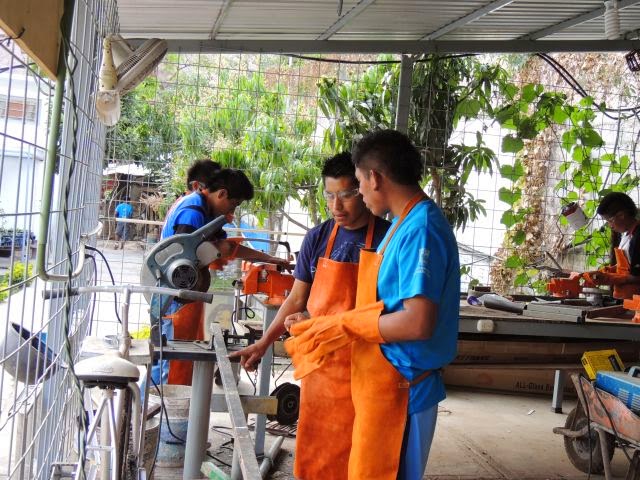
Alex's Welding Shop
“Alex’s Welding Shop” is now one of the favorite places for students at the Champagnat High School of the Mountain to “hang out”—as long as they’re doing something constructive and as long as they are observing all the rules in terms of safety and care of the machinery.
Many of the students never saw welding tools before in their lives
I love hanging out in the shop too—even as I confess that I’m seldom doing something constructive. But just watching the students interact and learn is a beautiful experience.
It's always easier working with someone else
The education offered at this school is incredible. The 245 indigenous students “follow” the regular Mexican curriculum, but they learn about their native cultures as well: the sacred stories, the customs, the rituals, the traditions, and the struggles that have nourished the cosmovision of their peoples for centuries.
"Now what did the teacher say this was for?" seemed to be a common reaction in the beginning
In his latest book, Change the Story, Change the Future: A Living Economy for a Living Earth, David Korten points out that “we humans live by our shared framing stories and have a deep need for a sense of purpose and meaning. If we do not share an authentic sacred story, the void will be filled with an inauthentic story—and that is our problem. An economy, a society, built on the foundation of a lie cannot work.”
"It looks like the right length to me"
Korten also mentions that “many indigenous people use the term sacred to refer to what is most important, most essential to the well-being of the community and its members, and therefore most worthy of special respect and care. It is in that sense that I speak here of sacred stories.”
"Wow, this is fun..."
Talking to the students in Alex’s Welding Shop proves that the “sacred story” motivating these students is one of what is “most essential to the well-being of the community and its members.” The students don’t talk about making money or getting ahead just on a personal level; they constantly refer to the difference that their learned skills can make in their school now and in their communities of origin afterwards.
There is classroom learning too for welding—here with Brother Checo, master welder
It was almost funny to be present in the first “hands-on” classes. Master welder Andrés invited the students to make something small: a table, a flowerpot holder, a window frame, a small chair—one student even made a barbell for weight lifting. He let them make tons of mistakes—and some of the finished products did produce laughter (including a table with the most uneven legs I’ve ever seen). But then, building on that initial effort, Andrés slowly and surely guided the students through the construction of the same item—this time using the tools and methods that an experienced welder would take advantage of in order to produce a high-quality product.
"I think this will work; all I need is the other end"
Alex Graf’s legacy is impacting lives in this remote mountain region of Mexico. “Changing the table” is not only “changing the story” for students and families and communities here; it is in a very real way “changing the future.” The students asked me to extend their gratitude to Alex’s family and friends and to Mission Mexico for helping them to have this life-giving experience. Alex is now part of their “sacred story.” I can’t think of a more incredible tribute. Thank you, Alex.

Tuesday, February 10, 2015

Placing Hope in Education for a Different Future

“Well,” said Pooh, “what I like best—” and then he had to stop and think. Because although Eating Honey was a very good thing to do, there was a moment just before you began to eat it which was better than when you were, but he didn’t know what it was called. — A.A. Milne, The House at Pooh Corner

I’m not sure what it was called either, but this quote came to mind last week as I was driving into the village of San Miguel el Progreso. I hadn't been there for about ten years, and I was really looking forward to seeing old friends. Just the anticipation of that encounter made the drive along the dusty road easier to handle (the view helped too: it was like driving to heaven; Elijah had his chariot, I had my truck).
Driving to San Miguel el Progreso
I was going there to deliver a supply of educational materials to the local high school. Forgive me for smiling as I re-read that line. The high school in San Miguel, with 104 students, is quite different from the image of a high school that most Canadians probably have. Consider the following photo of the outside of half of the high school:
 
The original classrooms of the high school (and still being used)
And the high school classroom is rather different than the classrooms that I used to teach in when I lived in Calgary:
A Grade 12 classroom in San Miguel
The parents in San Miguel have organized and formed an Education Committee that is, as they put it, “knocking on doors” of governmental and non-governmental organizations in the hope of improving their educational facilities. The state government did build them three new classrooms, but the committee is hoping for more: things like Internet service, a small library, a chemistry lab, a sports field (even if not regulation size), more teachers, etc.
Three classrooms recently built by the government
The 3,500 people who live in San Miguel basically live from growing coffee. Unfortunately, this year they are receiving a double whammy: coffee prices are low in the market, and many of the coffee plants in the area suffer from a plague called “coffee leaf rust.” I mentioned in a blog in September that “food and education” is a “marriage made in heaven” in terms of what most parents hope for their children. But food has to be the priority—and the upcoming year looks like it’s going to be a hungry one for many people in San Miguel.
Coffee beans drying in the sun in San Miguel
The principal of the high school is Fausto, a very committed young man. I used to teach him in the diocesan seminary before his life took a turn toward the field of education. He was born in San Miguel and understands the challenges that his people face. He is a wonderful example of someone who is using his abilities and energy to work for the well-being of his community.
Fausto and his wife, Adelina, in their kitchen-dining area
It is such a blessing to be allowed to be here and to accompany as best I can the efforts of so many incredible people as they struggle to create a better world for others. The many little and big things that Mission Mexico is able to do is multiplied by the renewed sense of commitment that many people experience when they realize that they are not alone in their struggle for life. Perhaps that is one of the best gifts that Mission Mexico offers.
Another (outdoor) classroom in the high school in San Miguel
So thank you to all who support Mission Mexico. You are making a difference in people’s lives. Have a great week.
Driving home from San Miguel at night can be an adventure too

Wednesday, December 31, 2014

Happy New Year from Mexico

There are a couple of hours left in 2014—just enough time to give thanks for the blessings of 2014, to wish you a Happy New Year, and to get ready for 2015. Maybe…
A new day is dawning in 2015 for the impoverished people in the mountains of Guerrero
The “Mission Mexico” projects went super-well in 2014. Hundreds of impoverished families in the mountains of Guerrero benefited—especially in the areas of health and education—from the solidarity shown by their Canadian friends in southern Alberta. Add to that the other thousands of families supported during the fifteen years that “Mission Mexico” has existed, and one realizes that “Mission Mexico” really has empowered a great number of people and witnessed to the gospel in an incredible manner.
Students from the Champagnat High School of the Mountains (one of
Mission Mexico's main projects) walk to the church in Potoichan
Of course, 2014 wasn’t an “easy” year in many ways. The “worst” event was undoubtedly the killing of three students (by police) and the “disappearance” of forty-three other students on September 26; all were studying at the rural teachers college in Ayotzinapa. Those 43 are just a small percentage of the more than 5,000 cases of “disappeared” people in Mexico in 2014, but the case mobilized protests throughout the country. As the Tlachinollan Human Rights Center—that represents the families of the disappeared youth, and that receives support from “Mission Mexico”—stated this week in an editorial in a newspaper called El Sur, “The circumstances that unfolded on September 26 removed the rubbish covering an obsolete political system and showed it for what it is: a bureaucracy that is decrepit, corrupt, quarrelsome, mean-spirited, insensitive, and delinquent.”
The papal nuncio of Mexico, Christophe Pierre, during a Mass that he celebrated
with the families of the 43 "disappeared" students on December 22, 2014, in the
 rural teachers college in Ayotzinapa, 
The murder of three priests in the State of Guerrero in 2014 raised questions too. The three priests weren’t even a little “radical”; they simply preached the gospel. Of course, living and working in situations of injustice and violence may lead one to develop a kind of “rogue theology” rather than “rouged theology” (as John Caputo expresses it in his book The Insistence of God). These priests—and others—have learned the truth expressed by Father Richard Rohr in his latest book, Eager to Love, that “it is ironic that you must go to the edge to find the center.” These priests—and others living on “the edge”—learned the truth of what Meister Eckhart expressed seven hundred years ago (regarding Psalm 85:10): “Compassion is where peace and justice kiss.” Living that compassion, unfortunately, means risking death in Guerrero.
Father Gregorio Lopez Gorostieta, one of the three priests murdered in Guerrero this year—
his body was found on Christmas Day, 2014 (last week)
These struggles, and others, will surely mark 2015 in the State of Guerrero. Mission Mexico will undoubtedly continue to do great work and to nourish change and hope as the year unfolds, but the context will be a difficult one. Why do I think that? I will briefly mention a few “ingredients” of this context.
Will life change for the better for these children in 2015? Hopefully...
The poverty will continue. In the mountains of Guerrero, the “new” minimum salary that will take effect tomorrow, January 1, will be 66.45 pesos a day. That works out to be about $5.25 Canadian—a day! Since most of the adults in the mountains have little formal education and few “skills,” minimum wage may be the best they can hope for if they can find employment.
One of the many protests that occur almost daily in the mountains of Guerrero
The search for truth and justice in the case of the “disappeared” students from Ayotzinapa will continue. I doubt that the government will ever provide answers that satisfy the families and those in solidarity with the families. The situation of Mexico is not much different from the reality of the USA described by Sheldon Wolin in his book Democracy Incorporated when he writes: “I am convinced that certain tendencies in our society point in a direction away from self-government, the rule of law, egalitarianism, and thoughtful public discussion, and toward what I have called ‘managed democracy,’ the smiley face of inverted totalitarianism.”
One of the many marches in Mexico City of the families of the 43 "disappeared" students
and others in solidarity with them
An educational reform that was passed by the federal government this past year is scheduled to be implemented on March 15, 2015. Thousands of teachers and their supporters have already been protesting this reform for months. Indeed, in most of the villages of the mountains, the primary schools have been deserted during the past three months. The unrest will undoubtedly continue, and probably increase, in 2015.
Another protest march in Tlapa
State elections are scheduled in Guerrero for June 7, 2015. A new governor, 81 municipal presidents, and state and federal congress people are scheduled to be elected. But there are many groups in the state who are already urging people to not participate in these elections and to not allow the actual voting to take place. As I write these lines on New Year’s Eve, at least 28 of the 81 municipal offices in the state are closed; they have been occupied for months by protestors who are “fed up” with the way the political system is failing to generate change and (in many cases) seems to be in cahoots with organized crime.
The banner reads: "Against the looting and the lying—the peoples of the Mountain.
Resist!—From the trenches of the forgotten."
The struggle over strip mining in the mountains will undoubtedly become more volatile in 2015. The federal government has awarded (without consulting the people living in the involved areas) mining concessions to many foreign companies—predominantly Canadian companies—in the State of Guerrero. One article in “The Gold Report,” from March 20, 2013 —“The Gold Report” claims to offer “insight, analysis and ideas about gold investment from the best experts in the gold industry”—begins thus: “The Guerrero Gold Belt, a sexy, new, developing mining district in the state of Guerrero, Mexico, has attracted some exciting explorers that have unearthed key discoveries. While several companies have gone on land-grabbing sprees, there’s still good news: the Guerrero is growing.” Another publication states that “Mexico is a trove of accessible mineral wealth.”
The villagers would love to believe that these new roads are being built
for them. But not many people do believe that...Welcome, mining companies!
 I daresay that the indigenous villagers in these areas see nothing “sexy” about these concessions, see nothing in the way of “good news” in these concessions, and would question who decided that “their” mineral wealth is “accessible.” The government is still investing tons of money in developing the infrastructure (roads, bridges, electricity) to allow these mining companies to actually begin exploiting for gold and other minerals, but whole villages—concerned, like many Canadian indigenous communities, about the impact of deforestation, water pollution, and hazardous liquid waste—have already vowed that they will not allow mining companies to operate in their regions.
Progress??? Development??? Justice??? The future???
Finally, allow me to mention the risk of death that people who live and work with the poor will undoubtedly face in 2015. In the state newspaper La Jornada Guerrero today (December 31, 2014), Abel Barrera, the director of the Tlachinollan Human Rights Center, is quoted as stating that 2015 will undoubtedly be “a time of greater social crispación” (tension; agitation; ugliness), and such a time will represent “a tenebrosa scenario” (dismal; gloomy; dark; sinister) for the defenders of human rights. Everyone knows that the violence and the killings and disappearances of people will continue in 2015. I had lunch the other day with Abel, his wife, and his 83-year-old father, and his father was begging—well, it was almost ordering—his son to quit the struggle. I know Abel well; he has no more intention of giving up the struggle than Jesus of Nazareth had two thousand years ago.
Abel Barrera, one of the most respected and beloved (by the poor) supporters of the
indigenous peoples of the Mountain
So, my friends, please pray for the people of the mountains of Mexico in 2015, and please support “Mission Mexico” if you can. Forgive me for mentioning the “dark side” of the context in the mountains of Guerrero. I assure you that there is a “light side,” and “Mission Mexico” is a respected and important partner in that “light side”: I promise to share more of that "light side" in 2015. Solidarity is so very important. Thank you for what you have done in the past; please do what you can in the future. Have a wonderful 2015.
Two of my best friends: Baltazar and his sister Antonieta
(they wish all of you a Happy New Year too)

Sunday, December 21, 2014

Celebrating Our Lady of Guadalupe in the Mountains

There is no doubt but that the feast day of Our Lady of Guadalupe is one of the major events of the year in the villages of the mountains of Guerrero.
Altar dedicated to Our Lady of Guadalupe in the Cathedral of Tlapa
Over 5,000 (mostly) young people from hundreds of villages and towns in the Diocese of Tlapa travel to Mexico City during the days leading up to the feast day of Our Lady of Guadalupe on December 12. Then, on December 8 or 9 or 10 (depending on the distance), they begin a relay run from the Shrine of our Lady of Guadalupe (located in Mexico City) back to their village, carrying a torch that was lit at the shrine itself. The runners tend to space themselves out at intervals of a hundred meters or so; after they pass on the torch, they are picked up by a truck and driven to the front of the line again.
One relay runner passing the torch to another on the way to Tototepec
Upon arrival in their village on December 12, the runners are received like royal dignitaries, with fireworks, confetti, flowers, music bands, processions, and a religious ceremony in the church. Everyone wants to light a candle from the torch that has come directly from the shrine in Mexico City.
One relay runner passing the torch to another on the way to Tototepec
Most of the villages organize a retreat in early December for the runners who will be participating in the relay run. Since I teach Scripture at the diocesan seminary, I was invited to speak with the young people in several villages about Mary in the Bible.
A runner from Atlamalcingo del Rio
Besides just sharing information about Mary in the gospels (and her one appearance in the Acts of the Apostles), I invited the participants to reflect on what it means to them to participate in this particular “devotion” to Mary. At the wedding feast at Cana, Mary invited the servants to do what her son asked of them. In the Magnificat, Mary refers to the humbling of the proud and the filling up of the hungry. What might it mean to us today in the mountains to have a devotion toward such a woman?
An all-male group from Tlapa praying for peace and a "better Tlapa"
In the Nican Mopohua, the 16th-century document in Nahuatl that refers to the appearance of Mary to the indigenous Mexican Juan Diego in 1531, Mary, Our Lady of Guadalupe, tells Juan Diego that she wants a church built among the conquered, impoverished indigenous people so that “there I will listen to their weeping, their sadness, to remedy, to cleanse and nurse all their different troubles, their miseries, their suffering.” What might those words mean today? Are we invited today to participate in this same mission?
Azucena and her son Robert running toward Tototepec
I also asked the runners what they intended to think about while they were standing by the side of the road waiting to receive the torch or what they intended to think about while carrying the torch. I remember quoting on a few occasions Rabbi Abraham Heschel’s quote in God in Search of Man [sic] that “awareness of the divine begins with wonder,” and Catholic philosopher John Caputo’s quote in The Insistence of God that “if the name of God is not causing us a great deal of difficulty, it is not God we are talking about.” What might these thinkers have meant; how might that impact our experience during the relay run?
An all-female group from Tlapa
Finally, I invited the runners to share about what their hopes were in terms of this relay run. What difference did they hope it would make in their own lives? What difference did they hope it would make in the village’s life? Would the Mary of the Bible—who is Our Lady of Guadalupe—hope that the flame of the torch might “image” a flame in our hearts that would not soon burn out?
The Guadalupan group for 2014 from Tototepec
It was an honour and a blessing to have this time with the relay runners. I think they enjoyed the interaction during the retreat, and I hope that the interaction helped them to experience their devotion to Our Lady of Guadalupe in a profound way. I know it has helped me.

Wednesday, December 3, 2014

Misery Loves Company—Doesn't It?

Several times in my life I’ve heard the expression “Misery loves company,” and I think I’ve always interpreted it as suggesting that unhappy people like other people to be unhappy too—which sounds like not too nice an attitude to have. But now I’m not so sure.
People lining up (sort of) to register for the assembly of Delegates of the Word
On the weekend I attended an assembly of the Delegates of the Word from the 26 villages that make up the parish of Xochitepec (several catechists came along to learn too). A “Delegate of the Word’ is the spiritual/religious “leader” in each of the villages; he or she coordinates activities such as prayers for the sick or deceased, paraliturgical services on certain days, religious education for children, pre-sacramental talks for parents and sponsors, ceremonies requesting rain, etc. The Delegate is chosen by the village in an assembly and is an important figure in the village life.
Father Juan addressing the assembly of Delegates and catechists
As the Delegates spoke about their role in their communities and what they think they need in order to exercise that role more effectively, I was struck by what one gentleman said about his service to his community. Basically, he said the following:

“In my village, when someone is ill, I pray for that person. I would love to be able to say to the sick person, ‘Here, take this money to buy medicine or to travel to a town where there is a doctor.’ But there is no way I can. I pray for the sick person, but I think that it is my presence and my accompaniment with the family that makes the biggest difference. The fact that they know that they are not alone makes a huge difference to them.”
One small group of Delegates preparing to report to the assembly
Maybe misery loves company, but true Christians love being that company to people in misery. That accompaniment is one element of Mission Mexico’s ministry in Mexico. We want to make a difference on a material level, but we try to respond to people’s needs at all levels—as did Jesus of Nazareth. And just "being there" with and for the other can make a difference.
Father Hector coordinating one of the sessions during the assembly
In an article in the July 2011 edition of Foreign Affairs, Paul Farmer states the following:

"Accompaniment" is an elastic term. It has a basic, everyday meaning. To accompany someone is to go somewhere with him or her, to break bread together, to be present on a journey with a beginning and an end. There's an element of mystery, of openness, of trust, in accompaniment. The companion, the accompagnateur, says: "I'll go with you and support you on your journey wherever it leads; I'll share your fate for a while. And by 'a while,' I don't mean a little while." Accompaniment is about sticking with a task until it's deemed completed, not by the accompagnateur but by the person being accompanied.
Some of the participants during morning prayer on Saturday (in front of statue of St. Mark)
In the “History” section of Mission Mexico on its website, Father Fred Monk, founding director, writes that one of my roles here  is to offer hands-on assistance and the solace of presence, love, solidarity and the gospel message to the people served by Mission Mexico.” I am grateful to my wonderful mentors and teachers—such as the Delegates of the Word—who guide me in this effort. And I am grateful to all the supporters of Mission Mexico who make this service possible. God bless.
Mike with some children from the local music group in Xochitepec

Wednesday, November 26, 2014

No Peace for the Government

This is definitely a “unique” time to be in the mountains of Mexico. The killing of three students from the rural teachers college in Ayotzinapa and the disappearance of forty-three of their companions on September 26 has enraged and mobilized people not only in this state of Guerrero but people from all over the country. The common theme of these protests is, as can be seen in the photo below, “If there is no justice for the people, let there be no peace for the government.”
This sign outside a junior high school in Axoxuca reads: "Ayotzi lives!! If there is no justice
for the people, let there be no peace for the government."
Different government offices have been blocked, ransacked, or damaged. The mayor’s office in Tlapa has been “occupied” for several weeks now. Different schools and colleges are closed; roads are blocked; there are protest marches almost every other day. And it looks like the protests will continue for some time.
The mayor's office and other city offices are closed in Tlapa
Three men are in jail who claim that they were part of the gang who killed and burned the forty-three students. But so many people distrust the security forces and the government that they demand proof of this. In the search for the students, more than ten unmarked graves were found, with more than sixty bodies in them, but none of those bodies have yet been identified as one of the students. So the protest continues.
These children haven't had school for two months now...and no end in sight
The Tlachinollan Human Rights Center of the Mountain (which has been a partner with Mission Mexico for many years) is the principal legal representative for the families of the forty-three missing students. Both the director, Abel Barrera (who has been to Calgary several times), and the main lawyer, Bidulfo Rosales (who had to spend time out of the country last year because of so many death threats against him), have been very, very busy lately. I had breakfast with Abel on Sunday morning; he had just returned from a quick trip to the offices of Amnesty International in Germany.
Abel Barrera, internationally recognized human rights activist
Bidulfo Rosales, main legal representative for family of the 43 disappeared students
At the same time that these struggles continue, life continues in many ways. The rainy season is drawing to a close. Families have been gathering their corn crops and putting the cobs out to dry. Then the kernels are removed from the cob and saved in large bags—and the hope is that there is enough to last until the next harvest.
One family in Tres Caminos drying their corn of many colors
And I was on the road a lot lately. I was in Yosondacua to deliver many bags of threads to a sewing coop for women. I was in Copanatoyac for a retreat for over 230 young people from that parish. I was in Xochitepec with Fathers Juan and Hector as they (along with their volunteer team of five young Mexicans from different places in the country) were preparing simple catechisms in the native me’phaa language for the twenty-six villages in the parish.
Distributing threads to women's sewing coop in Yosondacua

The cover for the catechism in the parish of Xochitepec; the me'phaa title means
"We Follow the Way of Jesus."
Of course, there is such a thing as overdoing it (especially since I’m not a kid anymore), and I did spend the last couple of days sick in bed. But the rest did it, and I’m on the go again.
I won the contest: my feet were the cleanest.
Thanks to everyone supporting Mission Mexico. Every little bit of solidarity is a huge spark of encouragement to the people, and the hope that is nourished is a big factor in continuing the struggle for a more just and dignified life here. God bless.
Mari, Baltazar, Gaudencio, and Eleuteria in Xochitepec