Tuesday, August 11, 2015

Farewell to Hector, A Grand "Astronomer"

These past few weeks have been among the busiest times I’ve had here in the mountains. I have been on the road all over the mountains, trying to help different families in different villages make arrangements for their children to continue their studies in different educational institutions. Our efforts didn’t always work out, but there have been more success stories than failures, and the people are super-appreciative of any “helping hand” they receive in trying to assure a more dignified life for their children.
In July, Carlos graduated from the Champagnat High School in Potoichan. Mission Mexico
helped him to get into a university to study "Sustainable Development."
But today was a sad day for the mountains. At noon today Father Hector Miranda, Missionary of the Holy Spirit, boarded a bus that would eventually deliver him to a new parish in the State of Tabasco. Hector has been my friend for many years, and readers of past blogs know that going to visit him and Father Juan Molina in the isolated, impoverished, indigenous, mountainous parish of San Marcos Xochitepec has always been one of my favorite experiences here in the mountains.
Fathers Juan Molina and Hector Mirando, two incredible human beings
But now Hector’s journey will take him to new places of service—and I will be one of many who will miss him terribly. As I was trying to think of the kind of special person that Hector is, a recent quote from Pope Francis crossed my mind.
Hector saying farewell to Eleuteria, one of many children whose life will never be
the same just for the simple fact of knowing Hector
In his encyclical letter Laudato Si’ On Care for Our Common Home, Pope Francis describes Saint Francis of Assisi. But the words he uses for Francis (in article 10) are an excellent description of Hector. Pope Francis writes:

“He was particularly concerned for God’s creation and for the poor and outcast. He loved, and was deeply loved for his joy, his generous self-giving, his openheartedness. He was a mystic and a pilgrim who lived in simplicity and in wonderful harmony with God, with others, with nature and with himself. He shows us just how inseparable the bond is between concern for nature, justice for the poor, commitment to society, and interior peace.
Hector "quemando vela" (burning a candle) during his last prayer service in the
small chapel used in Xochitepec by the Missionaries of the Holy Spirit
On Sunday, the farewell celebration for Hector in Xochitepec lasted for hours, because every single person in the village shared a few words with Hector before giving him his or her blessing. Hector is an avid reader, and he and I have conversed on occasion about many books and authors. It was easy to imagine that as the indigenous people were blessing Hector, he was thinking of some words penned by Kahlil Gibran in his book The Prophet:  “You have given me deeper thirsting after life. Surely there is no greater gift to a man than that which turns all his aims into parching lips and all life into a fountain.”
Hector blessing and being blessed
And I chose the title of this blog from another story penned by Kahlil Gibran, this time from a section in a book called The Madman—I know that it’s a book that Hector has reflected on much. One part of The Madman reads:
   
      In the shadow of the temple my friend and I saw a blind man sitting alone. And my friend said, "Behold the wisest man of our land."
      Then I left my friend and approached the blind man and greeted him. And we conversed.
      After a while I said, "Forgive my question, but since when hast thou been blind?"
      "From my birth," he answered.
      Said I, "And what path of wisdom followest thou?"
      Said he, "I am an astronomer."
      Then he placed his hand upon his breast, saying, "I watch all these suns and moons and stars."
I know that Hector will always "watch all these suns and moons and stars"
that are present in himself —and I hope that he can experience the same once again in Xochitepec
Hector, thank you for sharing your love and your wisdom with me and with the people in these mountains. To end, I just want to mention one more story—this one taken from a book that Hector encouraged me to read: Mirrors, by Eduardo Galeano. Galeano writes in that book:

The best paintings by Ferrer Bassa, the Giotto of Catalunia, are on the walls of the convent of Pedralbes, place of bleached stones, in the heights of Barcelona. There, detached from the world, lived the cloistered nuns. It was a one-way street: the gate closed behind them and it closed for good. Their families paid large dowries so they would merit the glory of being forever married to Christ. Within the convent, at the foot of one of the Ferrer Bassa frescoes in the chapel of Saint Michael, there are words that have survived, as if in hiding, the passing of the centuries. No one knows who wrote them. But we do know when. There is a date in Roman numerals, 1426. The words are barely decipherable. In gothic letters, in Catalan, they pled and plead still:

Tell Juan
not to forget me.
Hector and Juan—what a team! And what a blessing to be their friend!
Hector, I can promise you: Juan will not forget you. Nor will I. Nor will the thousands of people whose lives have been enriched by the blessing of knowing you. Thank you for so much. Our gratitude and our love and our support will accompany you. Farewell, my grand astronomer. 

Tuesday, July 14, 2015

Mission Mexico...Nourishing Hope

It was great to visit Canada for a couple of weeks in June, but it was also great to get back here to the mountains of Mexico. For some reason, I don’t experience as much “culture shock” going from Mexico to Canada as I do coming back to Mexico after a visit to Canada.
Calgary looked bigger after being away for a long time
It was “different” spending time in Calgary and area after not really having spent time there for more than ten years. My gratitude goes out for hospitality and lodging to Fathers Wilbert and William at St. Bonaventure Parish in Calgary, Father Fred Monk in Bow Island, Cal and Barbara O’Brien in Lethbridge, and Len and Margot Lang and family in Calgary. The welcome at St. Gerard’s Parish in Calgary was more than one could have hoped for. I had an incredible barbecue in Cochrane at the home of Joann Churchill. And the time spent with Colleen Flanagan and Rob Morgan and family was precious.
Thank you, Cal (and Barb), for the wonderful hospitality. Lethbridge is blessed to have you.
I loved visiting the Escuela St. John Paul II Elementary School in Calgary, St. Michael’s School in Bow Island, and Catholic Central High School in Lethbridge. It was a thrill to speak to students and teachers in these places. And it was an honor to meet and share the Eucharist together with the people in Bow Island and Foremost. What beautiful people everywhere!
Parishioners in Foremost with a banner sent to Father Fred and Mission Mexico from the villagers in Cuapala
I admit that it was sometimes difficult to share with people “up there” about what life is really like here among the impoverished indigenous peoples. I didn’t have a “prepared speech” or anything. On the one hand, the hopes and dreams of the people are the same as those up north: education, health, security, a better future. On the other hand, the struggle to achieve these “dreams” is so often a more difficult one here.
Mike and Reina in front of her house in Las Juntas
I probably “bragged” a little about the great work being done by Mission Mexico—but is it bragging if it’s true? I think I said somewhere up there that one of my ways of looking at the reality here is to contrast “poverty” and “misery.” I often think that almost everyone here is poor, but their situation can be considered “misery” if these poor people are confronting alone the challenges in their lives. Confronting challenges together nourishes hope…and hope destroys misery. Are the people still poor? Yes, in many ways…But working together for something new, something different, brings any dream closer to reality.
Baltazar is watering his dreams and hopes for the future...
And Mission Mexico is nourishing that hope in so many different ways. The lives of individuals, families, and communities are being changed. Mission Mexico is “partner” and “friend” with so many people struggling for change. And none of that would be possible were it not for the support of the people that I met in southern Alberta this past month. Thank you to one and all for sharing with these sisters and brothers in the mountains of Mexico. 
Thanks, Father Fred, for making possible my wonderful trip

Sunday, May 31, 2015

Loss of the Indispensable Ones

There are those who fight one day and they are good.
There are others who fight one year and they are better.
There are those who fight many years and they are very good.
But there are those who fight a lifetime:
those are the ones who are indispensable.
-       Bertolt Brecht

Those are words that were heard often last week after the tragic death in a car accident of Ignacio Suárez Huape and his wife, Inés Montaño. Indispensable—and incredible human beings. I knew them before they were married in the mid-eighties, and later I loved spending time with them and their wonderful children, Alondra and Mauricio (now in their twenties; Alondra was involved in the accident but is now recovering; Mauricio wasn't involved). Nacho had a more public profile (congressman, journalist, human rights activist), but Inés was supportive in all of his endeavors—besides being involved in her own causes. They will definitely be missed as the struggle for life with dignity and justice continues in Mexico.
Nacho and Inés at home one evening
I am most grateful to my great friend Gerardo Debbink for calling me immediately when he heard the sad news. Gerardo is the founding director of Quest Mexico, a non-profit organization in Cuernavaca devoted to social justice through transformative and experiential education. Hundreds of groups from Canada and the United States have taken part in Gerardo’s short-term and semester programs. And Nacho Huape was a frequent participant in Gerardo’s programs—I daresay an unforgettable one for all concerned. Thank you, Gerardo.
Gerardo Debbink of Quest Mexico and Nacho—two great persons
Nacho lived in Cuernavaca, State of Morelos, but he was always concerned about the difficult situation here in the mountains of the State of Guerrero. He called me by phone just a couple of weeks ago to talk about the upcoming state elections here in the state; the elections are scheduled for Sunday, June 7. There has been a lot of violence lately, and no one is too sure just what will happen on June 7. Indeed, in some places (including Tlapa), many groups have said that they won’t allow voting to take place. And more police and army have already shown up to see that the voting does take place. We’ll have to wait and see what happens.
The political advertising is still up for Ulises Fabián, candidate for mayor in Chilapa—a Chilapa
with order and peace, according to this sign. But he was murdered on May 1, 2015. Rest in peace, Ulises.
But life goes on in the mountains. And there are always lots of little signs of life. For example, the other day I happened to encounter Josefa, a woman who was operated on twice for cancer—once in 2002 and once in 2005. In both cases, Mission Mexico helped her get this medical care in Mexico City. She is fine now, and she asked how Padre Federico (Father Fred Monk, founding director of Mission Mexico) is. She will never forget his name.
Josefa—ten years after her last cancer operation
And in Xalpitzahuac last evening, Bishop Dagoberto Sosa Arriaga, bishop of Tlapa, unveiled and blessed a plaque beside the front door of a multi-purpose building (kitchen, health center, education center, meeting room) that is now known as the “Padre Fred Monk Room.”
Sister Lorena and Bishop Dagoberto during the unveiling and blessing of Father Fred's plaque
The light wasn’t great and I’m not a very good photographer, but the plaque (see photo below) reads:

To Mission Mexico — Canada.
Father Fred Monk
In gratitude
For your generosity and commitment
With our Nahuatl sisters and brothers
In the Mountain of Guerrero.
Thank you.
Sisters of St. Philip Neri in Xalpitzahuac
May 2015

Plaque for the Father Fred Monk Room (pretend you don't see the reflection of my image
as I took the photo). "Nahuatl" is the name of the local indigenous culture and language.
And it was a special honour to be invited on Mother’s Day, May 10, to the home of Doña Marcelina in San José Lagunas. Back in 1985, Doña Marcelina and her husband, Angel, invited me often to their home for a meal. This time it was her daughters who prepared the meal, but it was still a great visit.
Mike, Doña Marcelina, and her daughter Estela
In October of 1984, a younger sister of mine was ill in Canada with kidney problems, and I “gave” her a kidney (I put “gave” in quotation marks because I still tell her that she should pay me for the kidney that I “sold” her—no luck so far!). The doctors told me that I should take things easy for a few months, so when I returned to Mexico, I went to live in San José Lagunas for four months. I did take things easy: a bit of carrying water and firewood and a lot of visiting and learning. That was thirty years ago but I still have fond memories of those days.
Mike with children from San José Lagunas in 1985. Some of the children are
still alive thirty years later; too many aren't.
This coming Friday, June 5, I will be flying to Canada. The first week I will be in and around Calgary (is it politically correct to think of Cochrane, Medicine Hat, Bow Island, and Lethbridge as “around Calgary”?) Then I will visit family and friends in Regina before returning to Mexico on June 22. I hope to see old friends (and since I taught in Calgary in the late 70s and early 80s, yes, they will be old—okay, at least older). Have a great week, everyone.
Nacho, Alondra, Mauricio, and Inés.
Thanks for so very much, my friends.

Sunday, May 10, 2015

Reformulating Almost Everything I've Ever Learned

All day the words that Father David shared yesterday kept reverberating in my mind.
Father David—someday he will hopefully publish his journal with his "reformulations"
David is a “new” priest—ordained earlier this year—who came to the mountains three months ago, after receiving all of his priestly formation in different urban centers. In a meeting yesterday that was looking at how the diocesan church here might offer better service to the impoverished indigenous population of the mountains, someone asked David if he had any ideas to propose.
Fire (in this case, with candles) is a huge element in terms of interaction with the divine
I don’t remember his full response, but I do remember one expression he used. He smilingly said that he is still trying to put the pieces together, that the experiences with the people in the mountains is—in his words—“forcing me to reformulate almost everything I ever learned.” A lot of heads nodded in the meeting: almost everyone could identify with David’s “reformulating” journey.
The cross and flowers are two more important elements in most rituals
Of course, David had a stark introduction to the spirituality, rituals, and customs of the native peoples. He arrived in mid-February—just the time of year that many families begin to experience real hunger after their small corn crop from the rainy season begins to diminish. It can be a time of dehydration, malnutrition, sicknesses, and real suffering. And it’s a time when the people especially carry out rituals around springs or caves or the highest mountain around their village.
Offerings are made to ensure divine protection
These rituals are designed to propitiate the forces of nature, so that the new rainy season come as soon as possible, overcoming hunger and allowing corn—the life of the people—to flourish once again.  People pray, dance, sing, and offer sacrifices to the cosmic forces. The clouds are called upon to provide a good rain. The winds are invited to not blow too strongly through the corn fields. Lightning is requested to not cause any disasters. And the rain itself is asked to fall softly in order to fertilize well the fields.
Each flower in the necklace of flowers represents some pain or tragedy in the life of the person
preparing the necklace. Having the bishop bring these necklaces to God is a special
blessing in the eyes of the people here—and the bishop is fully aware
of the significance of this ritual.
A couple of weeks ago a group of doctors and dentists came from Mexico City to various villages in the mountains for five days. They offered free checkups to hundreds of children, youth, and adults. It was the first such experience for these medical personnel from a Catholic parish in Mexico City—but probably not the last. Besides just offering their service, they tried to get to understand the people’s perspectives on their lives, their illnesses, their hopes, etc. All the doctors and dentists admitted (like David even after three months) that such an understanding was going to take a lot longer than five days—and a lot of "reformulating."
Unpacking some of the dental equipment brought from Mexico City
Mission Mexico has been accompanying these people for more than fifteen years. Lives have been impacted in small ways and huge ways. The people here are truly grateful for the many signs of solidarity. And they pray too that God (God is the cosmic forces) reward each and every person who has supported Mission Mexico in its efforts to bring life to this very challenging reality here. Have a great week.
Medical and dental equipment loaded on the Mission Mexico truck

Tuesday, April 14, 2015

Distress and Eustress during Holy Week in the Mountains

I know that “eustress” isn’t the most common word in daily conversation, but the word came to me as I listened on Holy Saturday (the day before Easter) to more than one hundred young people talk about their experiences of living a week among some of the poorest people among the most isolated villages in the mountains of Guerrero.
A young "missionary," Araceli, visiting a family in Llano Grande.
Araceli, from Tlapa, is in her last year of study for a teaching degree,
thanks in part to a scholarship from Mission Mexico.
I remember that I first read the word in a book called Healing the Heart of Democracy, by Parker J. Palmer. In the book, Palmer made a distinction between “distress”—which is negative and destructive—and “eustress”—which is positive and a prod to growth.
Vladimiro—a near-perfect example of "eustress" rather than "distress"
 There was no doubt that the hundred young people from the states of Puebla and Tabasco and from Mexico City and Tlapa had “suffered” and “sacrificed” during their week in the mountains. The travel (breathing in dust on the back of trucks), the food (beans—and often only beans—every day), the sleeping arrangement (straw mat on a dirt floor), the language barrier (the youth spoke Spanish; many of the people in the region spoke only me phaa), the lack of comforts (no cell phone or Internet here), etc.
Palm Sunday procession in Xochitepec
But, amazingly enough, everyone was thrilled that they had had this experience among the indigenous poor. As one young man put it, “I kind of bragged before that I was Mexican. Now I’m not even sure if I know what it means to be Mexican. I never knew that people actually had to live like this in my own country. If these impoverished people live in Mexico, maybe I live above Mexico.”
Dani and Isa (from Tlapa) with children in Loma Macho
The youth had arrived on Palm Sunday to different villages in the parish of Xochitepec. I spent the full week in the parish, visiting different groups each day to be sure that all was going well. It was a week without seeing a paved road—and occasionally walking, driving and wading through rivers, and even crossing a swinging walk bridge (with missing boards) above a steep gully at one o'clock in the morning. The truck was continually in four-wheel drive, and I never got beyond first or second gear. The days were long—usually leaving in the dark and returning in the dark. But it was an amazing experience.
Mike crossing the swinging bridge in Rio Velero
The people in the villages were thrilled to receive these groups of four or five young “missionaries.” The young people interacted with the children, the youth, and the adults. They were encouraged beforehand to visit every single family in the village where they were staying. It was these family visits that most impacted them.
Children from Loma Macho learning through coloring about Jesus' life
So many families had sick children or sick mothers or sick elderly—yet this was just “daily life” for the people. The young “missionaries” felt impotent in responding to so many needs. Many had gone to the villages thinking that they would be “bringing the Word of God” to the people (in fact, one group even had that motto on their T-shirts); on their last day, these same missionaries articulated that the Word of God was brought more to them than to the people.
Eleuteria, Monica, Lizbeth, and Sara. Monica and Lizbeth are sisters
and lived in different villages during Holy Week. Monica is a university
student in Tlapa, thanks in part to a scholarship from Mission Mexico.
Another impactful experience for the young “visitors” was the re-enactment in the villages of the events of Holy Week. Without the presence of a priest, the villagers still relived the events of Jesus’ last week of life. The “re-enactment” wasn't always exactly faithful to the gospels—for example, one village washed hands at the Last Supper, not feet; another village used tortillas and Pepsi, not bread and wine; another locked up on Holy Thursday night the young man playing the role of Judas instead of the young man playing Jesus;—but everything worked out fine.
Jesus meets his mother in this Good Friday reenactment in Llano Grande
In the Holy Week issue of the newspaper that the diocesan seminary here in Tlapa distributes, I wrote an article about Jesus’ last week in Jerusalem. In that article I mentioned the importance and the beauty of reenacting the events of that week, but I also stressed that, as disciples of Jesus, we can’t forget what led up to the events of that week. My final paragraph went something like this (it reads better in Spanish than in English, I think):
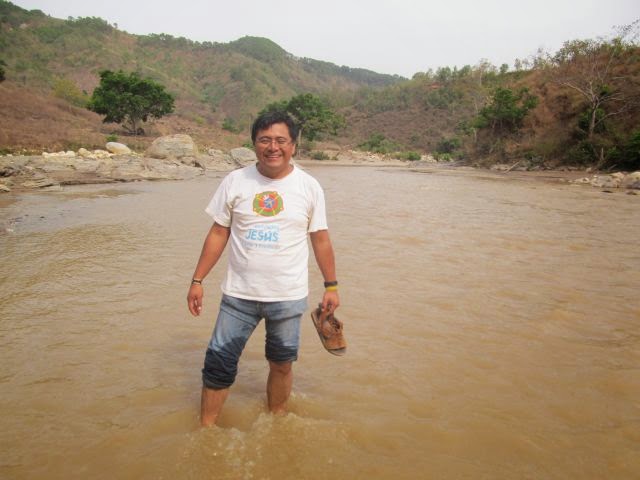
Father Hector walking to Rio Velero (he got us lost walking;
I still think he deserved to slip in the river and get soaked)
“Paraphrasing something written by José Antonio Pagola in his book Volver a Jesús (Turning Back to Jesus), we must remember that what was for Jesus the objective, the rationale, the heart of his message, and the passion that drove his life was the kingdom of God. We followers are invited not only to turn our lives over to God; we are invited to ‘seek the kingdom of God and its justice’; we are invited to collaborate with Jesus in working toward a world with greater justice, dignity, life, and love for all.”
Easter Vigil service in Xochitepec
I think that this was one of the “lessons” learned by the young “missionaries” during their Holy Week experience in the mountains. I think it is one of the reasons why Father Fred Monk started Mission Mexico. I think it is one of the reasons why so many good people assist Mission Mexico in its efforts to live and share this gospel message among the impoverished people here. Let’s hope that the future will show more signs of this kingdom of God in the mountains of Mexico—and in your life and in mine.
Driving in the early dawn (okay, maybe just a little
before the early dawn)

Tuesday, March 24, 2015

Grief: A Universal Experience

I know it was just a coincidence but still…the timing was incredible. I was driving to the village of Xilotlancingo, and I passed an open space high in the mountains where there was cell phone service for a couple of minutes. A beep alerted me that I had an e-mail; it was from Father Fred Monk, founding director of Mission Mexico. The message ended thus: “Take care and keep out of the ditch!! Fred.”
The road near where Godofredo went into "the ditch"
So far I’ve kept out of “the ditch.” That’s important because most of the mountain roads here don’t have a "ditch"—they have deep ravines that go a long way down. And on the day I received Fred’s message, I was on my way to the burial of a 21-year-old teacher, Godofredo, who had driven into such a “ditch” two days earlier.
Godofredo being waked on the dirt floor of his one-room house
Godofredo had just received a permanent teaching job a month earlier. In fact, he had received his first payment, but hadn’t had time to change the check at a bank yet. He and three cousins went off the road on a Saturday night. The three others are still in the hospital. Godofredo died at the scene.
Godofredo's mother, Wilfrida—her husband died two years ago, and she was living
with  her son Godofredo and his family
It was sad to attend the burial. I couldn’t help but think of the biblical book of Ruth, in which Ruth and her mother-in-law, Naomi, were left without a male presence to accompany them. In this case, it was Godofredo’s wife, Camelia, and his mother, Wilfrida, who were left without a male presence to accompany them. And to make matters even more difficult, Camelia now has to look after her two daughters on her own: two-year-old Arleta Alfonsina, and a newborn baby who doesn’t have a name yet.
Godofredo's wife (now widow), Camelia, and their daughter Arleta Alfonsina
Godofredo’s casket was carried from his house to the main square of the village, where the children from his class at school paid their last respects to him. Then the casket was placed on the back of a truck and driven to the cemetery outside the village. I followed that truck with family members and cement, flowers, candles, etc.
The truck driving Godofredo's body to the cemetery in Xilotlancingo
A trail of flower petals were dropped on the road all the way from the house to the cemetery. This was meant to make it easy for Godofredo to find his way home if he wished to do so on his journey to the next life. At the cemetery every person present (and that was hundreds) incensed his final resting place before the casket was lowered into it.
Godofredo's mother, Wilfrida, incensing his final resting place
Before closing the tomb, all of Godofredo’s clothing, shoes, and personal belongings—even a briefcase with school books—were placed alongside the casket in the tomb, so that these possessions would accompany him. Then the tomb was sealed as final prayers and hymns were offered.
Placing Godofredo's belongings inside the tomb with him
As a final detail, a baby chick was placed on the tomb, although it immediately began to wander around the cemetery. The chick is placed there because it can guide Godofredo to water if he needs that during his upcoming journey.
The baby chick meant to help Godofredo find water on his journey to "new life"
The grief expressed at this burial reminded me that grief is a universal experience. Yes, many of the “details” at this Mexican burial were different from those at a Canadian burial, but the sobbing, the crying, the tears, the sadness, the pain…these had no nationality. I don't travel that road too often, but I promised Wilfrida and Camelia that I would drop in to see how they are doing whenever I am near Xilotlancingo.
Some of the women present at Godofredo's burial
Today is the thirty-fifth anniversary of the assassination of Archbishop Oscar Romero in El Salvador. On one occasion he said, “There are many things that can only be seen through eyes that have cried.” The reality here often leads one to cry...but what one sees so very often is the compassion and the faith and the love of people who trust that, no matter what, together, incredible challenges can be surmounted. Mission Mexico tries to help make that happen. Thank you for being part of this effort.

Sunday, March 8, 2015

To Educate Or Not to Educate

It's that time of year again in the mountains. The sisters (nuns) from Chalco have come to the mountains to see if families in the impoverished villages want to send their children with them in August so that they can continue their education after Grade Six.
Sister Areli and Sister Jasmín, Sisters of Mary
The Sisters of Mary operate two schools, each one called Villa de los Niños. The school in Chalco, State of Mexico, is home to about 2,500 young girls; the school in Guadalajara, State of Jalisco, is home to about 2,000 young boys. These students enter after Grade Six and can study either just junior high school or both junior high school and high school. These schools are specifically dedicated to children from impoverished families throughout the country of Mexico. The education offered is completely free; everything from shoes to gym clothes to pens to notebooks is provided to the students.

Sisters preparing tortillas for breakfast in Xochitepec
It is interesting to speak with people about these schools. Some people think that none of the impoverished children from the Mountain should go there. Their thinking is that three or five years away from the families "changes" the students, so that they no longer "fit in" with the indigenous cultures and customs. Other people think that yes, the ideal would be that these children could be educated in their own village, but if the choice is between no education or an education away from home, then the education away from home is better. Especially since the students do return home for the Christmas holidays and the summer vacation.
Some Grade Six students in Xochitepec: Eleuteria, Lorenza, Bernardina, Marisol, Minerva
The sisters at  the Villa de los Niños are aware that their students come from many cultures, and they try to help their students feel proud of their backgrounds. Many of the sisters working at the schools were themselves students there at one time. And many of the teachers in the Mountain studied at their schools.
Sisters Areli and Jasmín meet Maricruz and Claudia, two teachers in Xochitepec
who had studied at the Villa de los Niños
I have been on the road a lot these past few weeks, helping families from the more isolated villages get to the villages that the Sisters of Mary are visiting. And in a few minutes I will leave again for a road trip so that families from around Pascala del Oro might meet with the sisters. If all goes well, I will be back here in Tlapa on Friday (I am writing this on Sunday).
Sometimes going to a village seems to be like driving toward the moon
Most of the week I will stay overnight with the Missionaries of the Holy Spirit in their parish of San Marcos Xochitepec. That's an extra bonus to being on the road. Fathers Juan and Hector have been working there for two years now, and Father David arrived two weeks ago to join their pastoral team. Mission Mexico helps them with some of their projects with the people, and I continue to learn and to be amazed by the incredible accompaniment they offer to their communities.
Fathers David, Hector, and Juan celebrating Mass in their house
Thank you, supporters of Mission Mexico, for helping families here move closer toward the dreams they have for their children. People here are aware of your love and solidarity, and they are most grateful. Have a great week. God bless.
When I was driving Father David to Xochitepec, we met Rosendo,
one of the leaders in the village of Cuixinipa, walking along the road