Tuesday, May 31, 2016

Hoping For a Different Future


We know everything about the poor: what they don’t work at, what they don’t eat, what they don’t weigh, how much they don’t measure, what they don’t have, what they don’t think, what they don’t vote for, what they don’t believe…

The only thing we need to know is why the poor are poor…Might it be because their nakedness clothes us and their hunger feeds us?...
-       Children of the Days

I thought of these lines by the great Uruguayan writer Eduardo Galeano quite often these past few weeks. They came to mind during two different scenarios.
It is such an honor to travel this sacred mountain to be with friends
Scenario One: Those who read my blogs know that my friend Edgar Peralta Silva broke his back a month ago while we were on a trip to an impoverished mountain village to share gifts with the children on the Day of the Child. I have visited Edgar several times in Mexico City, and I have been present while the family talk about what they can offer him and what they can’t offer him, what they can do and what they can’t do in terms of seeking rehabilitation.
Edgar's days are long...but he (usually) doesn't lose hope
Edgar is still paralyzed from the waist down, and he still can’t sit up. His family try to roll him over once in a while and to help him to exercise as much as possible. But he still gets sores on his back, and the skin on his feet and legs gets very dry. The doctors recommend a special cream for Edgar, but the small tube of cream costs 283 pesos: the equivalent of 21 Canadian dollars. The minimum wage in Mexico is 73.04 pesos a day: about 5.40 Canadian dollars a day. Edgar’s family want to offer him the best, but like all poor families, they have to consider priorities and real needs. Mission Mexico helps in some ways, but the family still faces incredible challenges.
Edgar continues his journey toward the new life that awaits him
Scenario Two: And much of my time was spent with Mexican young people who are finishing high school and trying to get into universities or vocational schools to continue their education. It is so wonderful when a family can opt to allow their child to continue studying, but there are too many cases where I have seen young people cry simply because the family doesn’t have the resources to cover expenses. Mission Mexico assists a few dozen students through a scholarship program, but the needs always outnumber the resources available.
Prayers for future dreams are a constant part of the lives of the poor
And the sacrifices that many young people make in order to study are often huge: one meal a day; walking instead of taking a bus; not visiting family for six months; borrowing books rather than buying them; looking for any kind of work possible on evenings or weekends; walking for long distances to a store that sells a notebook for a peso less than a nearby store. This is “normal” for the poor.
Future students at university? Not likely, unfortunately
The struggles won't end anytime soon. There are sad times, but there are also happy times. The joy experienced by young people who manage to go on to higher education is immeasurable. And families appreciate even the effort to try to help them offer to their children a dream for the future. This is an incredible place to be, and I am so grateful to Mission Mexico and its supporters for allowing me this blessing. Thank you from the bottom of my heart.
Not the fastest taxi around, but it can beat walking

Wednesday, May 11, 2016

I Collect Scars


Ella no creía en finales felices. Yo colecciono cicatrices.
She didn’t believe in happy endings. I collect scars.

This photo and quote were placed by Edgar on his Facebook page today. The quote is from a Spanish rap song called “Apolo y Dafne,” by Sharif. One can only try to imagine the thoughts in Edgar's mind and the emotions in his heart as he posted the photo (one he had taken in the past) and these words.
Edgar in his beloved mountains
Ten days ago Edgar was one of fifteen young people heading five hours into the mountains to share two truckloads of school supplies and clothing with children in the impoverished indigenous village of Aguaxoco. Twenty-two-year old Edgar, a student of Integral Community Development at the National Pedagogical University in Tlapa, had spent Holy Week in that village, and he and his friends wanted to surprise the children there with presents for the Day of the Child, a celebration held in Mexico every April 30. Unfortunately, the presents were never given out.
Edgar and friends praying in cathedral before heading for the mountains last week
We stopped in the village of Xochitepec on our way to Aguaxoco. Edgar wanted to go to a house down the side of the mountainside. A zigzag path led to the house. At one point, Edgar apparrently decided, instead of following the path, to jump down to the next level of the path that was a few meters below. But Edgar landed awkwardly, and his momentum led him to fall forward, down a steep ravine.
After the fall
It was evident that Edgar was seriously hurt. He complained about pain in his back and his chest, and he said that he couldn’t feel his legs. We tried to locate a doctor (by radio) from one of the nearby villages, but no such doctor could be found. We felt we had no choice but to bring him to the nearest hospital, in Acatepec. We placed him, with pillows and blankets, as level as we could in the truck, and I drove slowly (in four-wheel-drive low) for three and a-half hours over a terrible dirt road.
Arriving in Acatepec
In Acatepec, Doctor Alvaro gave him medication for the pain and sent him immediately in an ambulance—a three-hour drive—to Tlapa. He/we arrived in Tlapa at 10 PM. The next morning he was sent to a hospital in Mexico City.
The two trucks of gifts that never made it (yet) to Aguaxoco
On Sunday, May 1, doctors in Mexico City operated on Edgar’s spinal cord. They said that they found a jigsaw puzzle of broken fragments of bone. They placed two 50-cm bars alongside his spinal column. But they were unable to do anything that would allow Edgar to feel or move his legs. Two days later the doctors operated on Edgar’s fractured collarbone.
Edgar and four others from Tlapa with the children of Aguaxoco during Holy Week
Today, May 11, Edgar is supposed to be released from the hospital in Mexico City. He is still paralyzed from the waist down—at the moment. But he and his family—and all of his friends—have hope that rehabilitation and physiotherapy will allow him to recover from this paralysis. Time will tell.
Edgar in the hospital in Mexico City yesterday
Edgar’s family has asked me to bring them to Xochitepec this coming Sunday, so that they can “levantar la sombra” (“lift the shadow”) at the place where Edgar fell. This practice is common among the indigenous peoples here in the mountain. Once again, hope reigns supreme…
Edgar in Xochitepec with parish priests, Fathers Vicente and Juan
It was a tough week. I went twice to Mexico City to visit with Edgar and his family. As I sat on the overnight buses, I thought of the many families from Fort McMurray whose lives—like Edgar’s—were being turned upside down at this time. The scenes appeared on news channels here in Mexico. Edgar’s mother (Antonieta) and grandmother (Agustina) asked me to tell you that they are praying for you and your families “up there.”
Edgar losing a chess match to a formidable opponent in Xochitepec
Mission Mexico has helped so far with some of the ambulance fees, medical costs, and related items. Edgar’s friends have been gathering at the cathedral here in Tlapa every evening to pray for him, and they have been seeking donations to help cover some of the many costs. No one is sure what the future holds, but Edgar and his family will still confront many expenses: rehabilitation; travel; medical supplies; wheelchair; etc. If anyone reading this note about Edgar would like to help Edgar’s family, please give a donation to Mission Mexico. Thank you ever so much

Thursday, April 28, 2016

Trust—the Absolute

Don Antonio, the trusted xiñá (religious leader) in his village
Trust is the glue of a communal narrative. It is a given, the absolute without which all the rest doesn’t work.
   An Other Kingdom: Departing the Consumer Culture
                                                   Peter Block, Walter Brueggemann, John McKnight (2015)
 
A flavorful mango can turn a bad day into a good one
Trust—the absolute. Without it, all the rest doesn’t work. There is lots that “doesn’t work” in Mexico, and it seems that every day something occurs that leads the Mexican people to lose even more trust in their governing authorities.
Don Toño, who was the maintenance man at the orphanage in Tlapa when
Mission Mexico built a dormitory there in the year 2000 
This week the federal government of Mexico refused to renew permission so that the Interdisciplinary Group of Independent Experts (part of the Inter-American Commission on Human Rights) might continue their work in trying to determine the truth of what happened to the 43 “disappeared” students from the Ayotzinapa Teachers College, here in the State of Guerrero, in September of 2014. In reporting this decision, the New York Times used adjectives such as “corrupt” and “brutal” and “cruel” to describe the justice system in Mexico. How can one trust a government that seems to be doing everything possible to hide the truth of what happened to these students?
Members of the Interdisciplinary Group of Independent Experts
Trust—the glue of a communal narrative. Building trusting relationships with the poor and those who work with the poor is what Mission Mexico has been about since its founding. Jean Vanier expressed this well in his book called Community and Growth: In the end, the most important thing is not to do things for people who are poor and in distress, but to enter into relationship with them, to be with them and help them find confidence in themselves and discover their own gifts.
Don Margarito, who sells bananas to suuport himself in Yosondacua
Mission Mexico partners with people interested in helping the poor discover and nourish their gifts. Education plays a key role here. It can be a slow process—but it is a vital process. As George Monbiot expresses it in his book How Did We Get Into This Mess?: Politics, Equality, Nature, Progressive change requires mass mobilisation. But, by identifying and challenging power, by discovering its failings and proposing alternatives, by showing the world as it is rather than as the apparatus of justification would wish people to see it, we can, I believe, play a helpful part in this mobilisation…
Conrado and Icodia at their indigenous wedding ceremony at 4 in the morning
The Catholic Church here in the mountain of Guerrero is one such “partner” with Mission Mexico. The pastoral agents promote awareness and organization. The church respects the enculturation of the gospel in the lives of the indigenous peoples.
Bishop Dagoberto with Fathers Eugenio and Vicente in Xochitepec
The Tlachinollan Human Rights Center of the Mountain is another “partner.” The team at this center educates and accompanies—and defends—the people in their many struggles for justice and for respect for human rights.
Abel Barrera from Tlachinollan and family members of the 43 disappeared students
The Champagnat High School of the Mountain is another “partner.” This school offers quality education to about 240 indigenous students a year. The students come from different cultures, and their learning is not simply “academic” (although that is an important element). The students learn to see “the world as it is rather than as the apparatus of justification would wish people to see it,” and they learn to work together to seek ways to transform life in their impoverished villages.
Brother Cepillo, who has been at the Champagnat High School since its beginning in 2004
And every day Mission Mexico gives a helping hand to other organizations or other people struggling for life here in the mountains. This occurs because of the trust that others have in Mission Mexico. All of this assistance couldn’t occur if generous people in southern Alberta didn’t have this same trust in Mission Mexico—trust that their solidarity is helping to make a difference in the lives of the poor here. Thank you for this trust.
An honor to be invited to the wedding of Conrado and Icodia

Wednesday, April 6, 2016

Holy Week 2016 in the Mountains

Norma attending the Easter service in Xochitepec
To say, “I believe in Jesus Christ…who rose from the dead,” then, is to say I believe that the Resurrection goes on and on and on forever. Every time Jesus rises in our own hearts in new ways, the Resurrection happens again. Every time we see Jesus where we did not recognize him before—in the faces of the poor, in the love of the unloved, in the revelatory moments of life—Jesus rises anew. But that is not all. The real proof of the Resurrection lies not in the transformation of Jesus alone but in the transformation awaiting us who accept it. To say, “I believe in Jesus Christ…who rose from the dead” is to say something about myself at the same time. It says that I myself am ready to be transformed. Once the Christ-life rises in me, I rise to new life as well…Resurrection is about transfiguration.
                                                         —from In Search of Belief by Joan Chittister (Liguori).  

Children in Alcamani playing during Holy Week

This transformation/transfiguration spoken of by Joan Chittister is nowhere more evident in the mountains of Guerrero than during Holy Week. All of the villages have their customs and traditions; it is rare that there be no procession on Palm Sunday or celebration of the Last Supper on Holy Thursday or via crucis (way of the cross) on Good Friday.
Palm Sunday procession in Xochitepec
Veronica wipes the face of Jesus in the via crucis in Pozolapa
Of course, there are often differences. For example, it is not uncommon to have a “washing of the hands” ceremony on Holy Thursday rather than the washing of the feet. The same sense of service and loving-kindness is shared. And the bread and wine used by Jesus at the Last Supper often becomes tortillas or crackers and Pepsi or juice in the villages.
Foot-washing service in Llano de la Parota
This year hundreds of young people (and a few not so young) from other areas of Mexico visited the mountains during Holy Week and lived in different villages. I spent the week in the parish of Xochitepec, where every one of the 26 villages of the parish received such a contingent of young people. These young people coordinated the Holy Week services with the local leaders, and they visited families, and they interacted with children, youth, and adults.
Young people journeying to the mountains in the Mission Mexico truck
One group of young people in Aguaxoco: Bart, Ita, Edgar, Edilberto, Coco
My admiration for the sacrifices endured by these young people is beyond measure. They had to adapt to local ways of living in an area of scarcity, and everyone not only endured the experience—they loved the experience. If church is about community, they built community. If church is about love, they witnessed to love.
Children in Aguaxoco participating with the young people from Tlapa
I was privileged to accompany Father Vicente, a Missionary of the Holy Spirit, as we went around during the week to see how the different groups of young people were doing. It was amazing to see the joy not only of the young people, but of all of the members of the villages where the young people were living.
Father Vicente is in his first year of service in Xochitepec. The past four years he was
studying Canon Law in Madrid, Spain. Just a little contrast...
Of course, Vicente and I couldn’t “hit the road” without our favorite copilot, Ramiro, an architect from Mexico City who comes each year to Xochitepec for Holy Week. Ramiro is a great artist, and he brought with him all kinds of paints, paper, brushes, markers, crayons, etc. The joy he brought to hundreds of children who were able to express their creativity in color was immense. I daresay that most architects spend Holy Week vacationing at some beach; Ramiro and his wife, Beatriz, and their daughter Maria, and Maria’s boyfriend Eduardo spent the week helping to bring transformation to the lives of the indigenous people in this impoverished mountain region.
Ramiro—an incredible human being!
Painting in the village of Plan Ranchito
It was a most tiring but rewarding week. Resurrection hope was rekindled in the lives of many. Lives—of the young people visiting? of the people in the villages? mine?—were hopefully transformed and transfigured. Hopefully all of us are strengthened in our resolve to work for and witness to the new life that every human being should be joyfully experiencing. That is my wish for all of the people who read this note. Happy Easter!
Jesus crucified between the two thieves in Pozolapa
New flame—new life—kindled in Xochitepec
Easter morning in Xochitepec

Tuesday, March 15, 2016

They Wanted to Bury Us, But They Didn't Know that We Were Seeds

"They Wanted to Bury Us, But They Didn't Know that We Were Seeds." ---
a banner in the city of Iguala where the 43 students were "disappeared" in September 2014
I don’t know if I am getting older and therefore I just seem to be always busy and a little tired, or (more likely) that more and more people are becoming aware that Mission Mexico is a trusted partner in working for new life in the mountains of Mexico. But definitely every day seems to be filled with experiences involving the struggle for transformation and justice and life in this impoverished, indigenous mountain region.
Some of the mothers of the 43 disappeared students from the teachers college in Ayotzinapa—
seventeen months of searching and hoping
The most unforgettable experiences for me are those involving the families of the 43 teaching students who were “disappeared” in September of 2014. The mothers and fathers and family members continue to try to find clues to their whereabouts. Many people—government reps, business people, even church people—suggest that this search for answers should be abandoned, that their search often disrupts “normal” life for others. Three of the church people who tirelessly support these families are my good friends, Fathers Eugenio and Juan and Vicente. It is always an honor to accompany them when they interact with these noble families.
Father Eugenio with two mothers whose sons were among the 43 disappeared seventeen months ago
And last week was “exam week” for hundreds of poor students in the mountains who hope to study junior high school and high school at boarding schools run by a religious congregation called Sisters of Mary. These sisters educate 3,000 female students a year at their school in Chalco, State of Mexico, and 2,000 male students a year at their school in Guadalajara, Jalisco. This education is completely free. I drove two Sisters of Mary to several remote areas of the mountains, where they offered a simple written examination to interested children and interviewed the children and their parent(s). The Sisters have been involved in this educational effort in Mexico since 1991, and graduates of their schools are playing a transformative role in many villages of the mountains.
Sisters Areli and Marcelina during their trip to the mountains
When in any village, it is always an honor to be invited by a family to accompany them when they bury a family member. Last week twenty-year-old Teodoro Nava Cayetano was buried in Xochitepec. He had left the village to work at a job delivering tortillas by motorcycle in the coastal city of Acapulco, but he was struck by a car and killed. All the “usual” customs were followed: placing his belongings and food in the casket for his journey to new life, leaving a small chick at the grave site so that the chick might guide Teodoro to water sources during his journey, etc. Candles and flowers and incense are especially important.
Leo Tolstoy said it well, in Ana Karenina: "All happy families are alike;
each unhappy family is unhappy in its own way."
Another experience the past while has been participation in preparing a group of fifteen young people from Tlapa (where I live) to go to three different isolated mountain villages during Holy Week. I will bring them deep into the mountains on Saturday. It is a challenging week for these youth, but something that marks them deeply. They will interact with children, youth, and adults. The young people from Tlapa are aware that they are going to these areas to learn; they know that their presence is the best witness to their faith; and they know that the quality of any interaction with the indigenous poor is more important than the quantity of activities carried out. It will be interesting to afterward evaluate with them their experiences.
Family members of the disappeared 43 during an outdoor Mass on March 3
May Holy Week be a special time of new life for all. May you share in the love and strength of the mothers and fathers of the 43 disappeared young men from the teachers college in Ayotzinapa. Alive they were taken away; alive we want them back!
Teodoro's mother preparing all of Teodoro's belongings so that they can
be buried with him as he moves on to his new life
Father Juan in his kitchen in Xochitepec

Sunday, February 28, 2016

Filiberto, Rest in Peace

A few minutes ago I received a phone call from the village of Xalpitzahuac and received the sad news that twenty-one year-old Filiberto Octaviano Flores died a few hours ago. Rest in peace, my friend.
Filiberto in a photo taken a couple of months ago
Filiberto was one of the kindest, gentlest persons I have met here in the mountains. A couple of months ago he gave me a handwritten note directed to Father Fred and Mission Mexico. The note read as follows:

Father Fred, my name is Filiberto Octaviano Flores, and I am writing this letter to you because I got sick. The doctors sent me to Mexico City, but you know that in the Mountain we don't have much money. I am asking you to please help me, because I'd like to get better. I am married, and I have two daughters: one is four years old, and the other is ten months old. We are from Xalpitzahuac. I participate in the group of the Lady of Guadalupe relay run, and there Sister [Lorena] told us about you and the persons you help in the Mountain. My brother is going to accompany me, and my wife is going to stay to look after my daughters and to work in the field because we are peasant farmers and from our work we get what we need to eat. Father, you are aware of the need that there is in our village. For that reason I ask you to help me. I ask too that you pray for me. Thank you.
This is a copy of Filiberto's handwritten note
Yes, Mission Mexico helped Filiberto. In Mexico City the doctors said that Filiberto was suffering from anemia and leukemia. During the past few months Filiberto made several trips to Mexico City. But his struggle for health has now ended. Tomorrow his final journey will be to the village church and cemetery in Xalpitzahuac. The future for his wife and two daughters will be a difficult one.
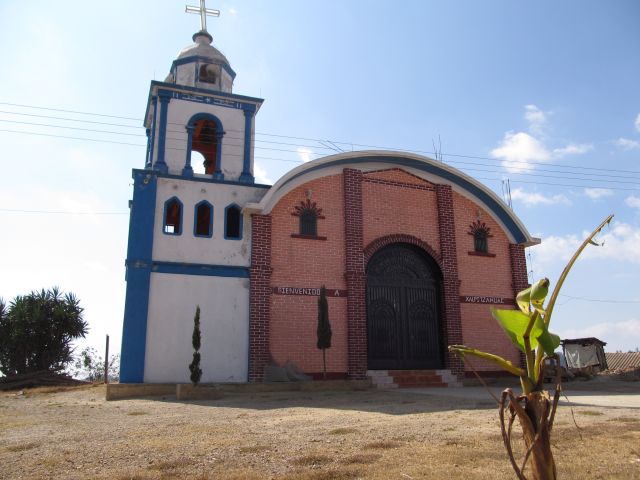
The parish church in Xalpitzahuac
Filiberto’s fate certainly makes me think differently in terms of my own health problems. For about a month now I have been ill with a sore throat and dry cough. Mine could be the words that Charles Dickens penned in the mid-1800s: I am at the moment deaf in the ears, hoarse in the throat, red in the nose, green in the gills, damp in the eyes, twitchy in the joints and fractious in temper from a most intolerable and oppressive cold.
This is what a sick Mike MacDonald looked like two weeks ago
During that month I actually visited six different doctors here in Tlapa. All prescribed medicines for me; three gave me injections. Nothing worked. Finally, my good friend, Abel Barrera, director of the Tlachinollan Human Rights Center of the Mountain, insisted that I visit a friend of his, an otorrinolaringólogo (ear, nose, and throat specialist) in the state capital of Chilpancingo. The medicines that Doctor Javier Cuevas gave me seem to be working, and I am now feeling quite a bit better. I might mention that when Doctor Cuevas saw the list of medicines prescribed for me by the doctors in Tlapa, he first laughed, and then he got angry. He said that it was no wonder that I wasn't getting better. 
Part of Doctor Cuevas' recommendations was to use a nebulizer three times a day for five days
I am grateful to Abel Barrera for insisting that I go to see this specialist, and to Benito for driving me there and back. Abel arranged this even though he was busy preparing an acceptance speech for an award he received last week in Mexico City from the National Council for the Prevention of Discrimination (CONAPRED). Abel ended his acceptance speech with these words: “I dedicate [this award] to the fathers and mothers of Ayotzinapa, who are struggling so that we might see a Mexico where the only thing that disappears is injustice and discrimination. Alive they [43 students from the teachers’ college in Ayotzinapa] were taken away; alive we want them back!”
Thanks to Abel Barrera—and congratulations on his latest award
I am also grateful to the many people who visited me while I was ill. Many brought me fruit or soup or other food. Doña Margarita, a well-known “healer” in the village of Copanatoyac, visited me at home more than a half-dozen times, usually accompanied by her daughter Herandy; that led to massages, teas, sauna bath, reflexology, etc. Everyone seemed to want me to get better. (That definitely includes my two sisters and two brothers in Canada, who seemed to be more worried about me than even I was.)
Herandy and her mother, Margarita—thanks for everything, my friends
Being ill also meant that I didn’t go to any location to see Pope Francis during his six-day trip to different parts of Mexico (February 12–17). Back in Rome, Francis expressed his gratitude for this “experience of transfiguration,” in which he experienced firsthand “a body that has been wounded so many times, a people that has so many times been oppressed, despised, desecrated in its dignity.” The people of Mexico—especially the marginalized and impoverished—are most grateful for this visit by the pope.
Pope Francis praying at the Shrine of Our Lady of Guadalupe in Mexico City