Friday, September 16, 2016

"I Will Move Mountains To Be With You"

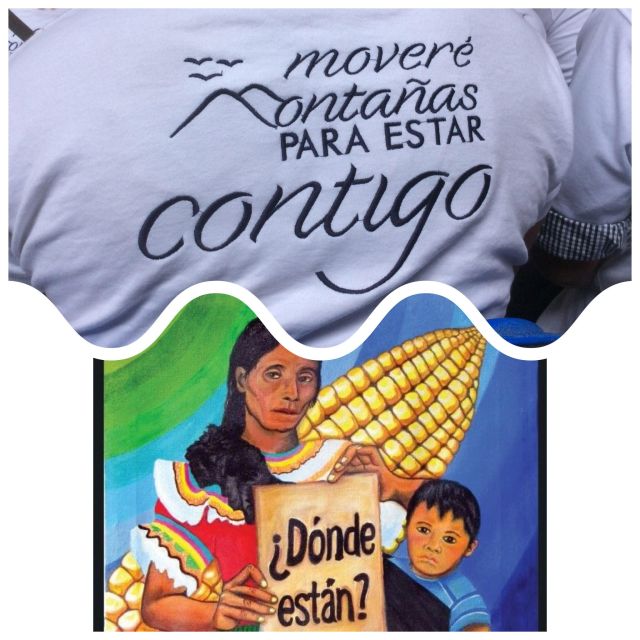
The shirt reads "I will move mountains to be with you."
The drawing asks, "Where are they?"
It is hard to believe that it is going to be two years on September 26 that 43 students from the teachers’ college in Ayotzinapa were disappeared—and it’s even harder to believe that the families of the young men are no closer to knowing what happened than they were two years ago. The logo on the shirt of one of the fathers expresses the determination of the family members: “I will move mountains to be with you.”
A march in Tlapa by family members, friends, and supporters of the 43 disappeared students
The families attempt every avenue (including marches, as in the photo above, and Masses, as in the photo below) so that the government will investigate every possibility to determine exactly what happened that night of September 26, 2014, but it has been like running into a brick wall. Just this past week the government’s lead investigator, who is accused of planting false evidence so that everyone would think that the 43 were burned at a remote garbage dump in Cocula (a theory debunked by a committee of international experts), was named a member of the federal government’s National Security Council. That is not exactly an encouraging sign for the families and those who support them.
The 22nd anniversary of the Tlachiinollan Human Rights Center began with a Mass in Tlapa
for the disappeared students from Ayotzinapa and their families
One of the organizations that has most supported the families of the Ayotzinapa students has been the Tlachinollan Human Rights Center of the Mountain. Tlachinollan recently celebrated its twenty-second anniversary. The founding director, Abel Barrera (theologian and anthropologist), is one of the most respected spokespersons for the causes of the indigenous peoples in the mountains, and he and Tlachinollan have received several international awards. Mission Mexico is honored to partner with Tlachinollan in some of its projects.
Abel Barrera with Father Juan: Abel with Bidulfo, one of Tlachinollan's lawyers;
Abel with Arturo (singer and poet and activist, from Cuernavaca) and Mike
September is also the month in which the Champagnat High School of the Mountain, located in the village of Potoichan, opened its doors again for another academic year. An extension to the dormitory for women meant that eighteen more young women could study there this year; the total number of students is presently 258. The school is specifically designed for indigenous students who come from impoverished families in villages where there is no high school. Mission Mexico helped to build this school, and it continues to support the school in different ways.
News students at the high school; Mike with Marist Brother Salvador, who has worked at the school
 since it opened in 2004; Yarabi and Nohemi check out the new dormitory
The rainy season continues, and the roads seem to get worse and worse. There are days when no travel is possible, due to landslides or roads simply being washed away. And there are other days that the mud makes downhill and uphill travel rather difficult. But such is “normal” life here in the mountains.
Photos taken on September 14...the road to Zitlaltepec and San Marcos
For example, on Wednesday I went to San Marcos to bring Juana to Tlapa so that the doctors could check her burnt foot. The doctors are pleased with the healing process, although they did remove yesterday the bones on a couple of her toes. On Sunday I will bring Juana back to her village. The five photos above show parts of the road that I traveled on Tuesday. I am hoping that the roads will be no worse on Sunday. The Mission Mexico truck comes in handy for medical situations like this one.
Juana at home; one sees her mother and father and brother and little cousins 
And last weekend I went to Mexico City to visit Edgar, the young man who fell down a ravine on April 29 while bringing school supplies to children in the impoverished indigenous village of Aguaxoco. Four and a half months later, Edgar has more freedom with his upper-body movements, but he still has no sensation below the waist, and he still can't sit up at a 90-degree angle. Mission Mexico helps with some costs and assists some of Edgar’s poor friends from the mountains so that they can visit him (and encourage him) in Mexico City. Today happens to be his 23rd birthday. Happy Birthday, Edgar.
Edgar on September 11; the CAT scan from September 4 shows
how serious his injury is
Another priest arrived this week to join the pastoral team in Xochitepec. Father Hector (nicknamed Tato) has joined Fathers Juan and Vicente in accompanying the mephaa indigenous people in the 28 villages of that isolated area of the mountains. Mission Mexico supports this pastoral team in its efforts to work with the people for a life with greater dignity and justice.
Father Juan, Father Tato, Father Vicente—from a congregation called
Missionaries of the Holy spirit (MSpS)
And the violence continues. Another fine young man (and friend), Francisco, was recently murdered. Francisco’s sister and her husband and their two children are among my closest friends here. What can one say at times like this? Just “being there” is probably more important than any words that can be expressed.
Francisco, the friendliest and kindest person one might hope to meet—recently murdered
So life goes on. Tomorrow I will visit a sewing cooperative operated by a group of students studying accounting here in Tlapa. The students come from different villages and wanted to support the poorer families in their villages. So Mission Mexico helped them to buy a couple of sewing machines and some initial materials, and they are now busy producing school uniforms, dresses, shirts, etc. Maybe I will have photos from that cooperative in my next blog. Thank you, everyone who supports Mission Mexico. Enjoy the rest of this month of September.
An early-morning sunrise in the mountains

Thursday, August 18, 2016

Back to School in the Mountains

Education cannot be neutral. It is either positive or negative; either it enriches or it impoverishes; either it enables a person to grow or it lessens, even corrupts him. The mission of schools is to develop a sense of truth, of what is good and beautiful...If something is true, it is good and beautiful; if it is beautiful; it is good and true; if it is good, it is true and it is beautiful. And together, these elements enable us to grow and help us to love life, even when we are not well, even in the midst of many problems. True education enables us to love life and opens us to the fullness of life.
                        -- Pope Francis—May 10, 2014
This is one of the most challenging times of year here, trying to assist families as they arrange educational opportunities for their daughters and sons. In the villages families often lack official documentation and often have no idea about the requirements in different schools and universities. It is amazing the amount of sacrifice that so many young people are willing to endure just to be able to continue their education.
Just a few of the many young people supported by Mission Mexico so that they can study
Mission Mexico has a scholarship/bursary program to assist some students who have exhibited leadership skills as well as an evident desire to be involved in transforming the reality of their impoverished villages. As Abad phrased it recently in a note he wrote, Cada quien con una carrera diferente pero por un mismo propósito: Ser para Servir. That translates into: “Each one with a different career but for the same goal: To Be to Serve.”
A view of the Champagnat High School of the Mountains, a place where students
are encouraged "To Be to Serve."
Of course, the rainy season doesn’t make it any easier to travel from the villages to the cities where there are universities. Just last week I tried to get to a village called Plan de Gatica, but I had to give up; there were at least six places where the road had either been washed out by the torrential rains or where there were huge mudslides blocking the road. And I had to take a different route back to Tlapa because of a huge mudslide that blocked the road between Xochitepec and Aguatordillo.
Recent photos along the mountain roads
I was fortunate enough to be able to get to the village of San Marcos without any serious problems. Juana, who suffers from epilepsy, had passed out in her house, and her foot fell into some burning coals in the middle of the floor. The doctors in Tlapa did what they could and wanted her to go to Mexico City, but her elderly parents insisted on bringing her back home to her village.
Hopefully Juana's family is cleaning her burn regularly, as instructed by the doctors
Before I left San Marcos to return to Tlapa, Doña Simona, Juana’s mother, insisted that I accept a gift for helping them return to their village. So I now have in my room here a wonderful servieta embroidered by Doña Simona.
Doña Simona offering me a servieta as thanks for bringing her daughter home to her village
Last week was also a sad one for me because a very good friend of mine who worked as a taxi driver in Tlapa was savagely murdered. I first met Ricardo Diaz more than twenty years ago, and he always had a ready smile for all. He joked about accompanying me to Canada once the visa requirement is lifted for Mexicans (something supposedly scheduled for December of this year), but, alas, such will not happen now.
Ricardo, thanks for so many great memories
So the days fly by, and I always seem to have something to do. I was going to write this blog last night, but at about seven o’clock four students showed up at my door and said that they didn’t have all of the papers that they needed to start school today. So I drove them to their village to get the missing documents; we got back to Tlapa at 11:30 PM. Tired but content that these students can continue their education…
Mike in San Marcos Xochitepec; the smaller stone represents St. Mark of the Rain
The rain will continue for a few more months. Here in the mountains it is Saint Mark who is associated with the rains. So far Saint Mark has been doing a good job. Hopefully he will continue to be happy for a more more months…
This photo of Father Juan Molina, MSpS,, was taken by Beatriz Alessio;
Juan is one of my best friends, and I love the photo...this is the real Juan...
Thanks to all who support Mission Mexico and help to make a difference in the lives of these beautiful, noble people. Enjoy the last few weeks of August. God bless.

Saturday, July 23, 2016

"There Is an Emergency Happening All the Time"

The mountain mist covers a world of darkness and light, sadness and joy
When a disaster strikes, the emotional centers of our brain flare up: we think— emergency! We forget there is an emergency happening all the time, because we’ve grown accustomed to everyday emergencies like disease and poverty and oppression.
-       MacAskill, William. Doing Good Better: How Effective Altruism Can Help You Make a Difference (p. 60). Penguin Publishing Group

The journey to a new future is not an easy one
Life goes on in the mountains here in Mexico. There are emergencies happening all the time, but there are lots of signs of hope too. The peasant farmers are presently quite happy with the rainy season that began in June. The question always is, though: Will it last? The rainy season is supposed to continue to the month of October, but dry spells have not been uncommon in recent years.
I love driving in the rain...and music from the Trinitarian Sisters of Mary, in Tijuana, is nice too
July is the month when school vacations begin, and I have been invited to many school graduation ceremonies. In a region that has about 700 villages, I couldn’t accept all of the invitations. The graduation ceremony at the Champagnat High School of the Mountain, in the village of Potoichán, was a special occasion. Eighty students graduated this year. A lot of tears flowed, but the pride of the parents was evident. Mission Mexico partners with the Marist Brothers of Mexico in helping to offer quality education to indigenous students from impoverished villages where no high school exists.
Marist Brother Salvador Gonzalez (Cepillo) has been at the Champagnat High School
of the Mountain since its founding in 2004 and is loved by all
Abel Barrera, the director of the Tlachinollan Human Rights Center of the Mountain (another partner of Mission Mexico), was guest speaker at the closing ceremony of the CIESA High School in Tlapa. He encouraged the students to be grateful for the sacrifice of their parents, to be proud to be from the mountain of Guerrero, and to strive throughout their lives to help create a society in which all people can live with dignity, justice, and hope. In a way, he asked the students (using the words of the initial quote in this blog) to not grow accustomed to the “everyday emergencies” of disease and poverty and oppression that are so prevalent here.
Abel Barrera with Ita Meztli; Ita graduated with a 9.8 average
It is always nice to see families actually celebrating an achievement of a family member. So many sacrifices are involved in educating children. There is an intense struggle going on in the whole country of Mexico right now regarding an “educational reform” that was passed as law in 2013 but has yet to be implemented. One Mexican intellectual, Adolfo Gilly, suggests that implementing the “educational reform” would be “selling the soul of the nation to Big Money” (La Jornada newspaper, June 22, 2016).
Two proud mothers at the kindergarten graduation in Xochitepec
Mission Mexico will continue to accompany these impoverished families as they struggle in so many different ways to create life in a situation of so many challenges. Thanks go out to all of the Canadians who support this valiant effort by these noble people. Your solidarity is making a difference in lives here.
Mike and some friends in Tlacoapa
PS: A blast from the past...The other day I was in the village of Xalatzala. In the summer of 1980 a group of high school students came with me to Mexico to visit Father Lawrence Moran, CSB. We stayed in the village of Tototepec, and one of our summer tasks was to paint the interior of the church in Xalatzala. Luis Flores (now living in Calgary) installed the first electrical lights in the church. The people in Xalatzala still remember their first experience with Canadians back then.
The church in Xalatzala as it appears today
PPS: Several people have asked me how my friend Edgar Peralta Silva is doing since his tragic fall on the mountainside almost two months ago (described in my blog on May 11, 2016). Edgar is staying at a brother's house in Mexico City and is still receiving therapy. He can sit up in bed now, but he still has no feeling below his waist. Hope never dies.
Edgar in his brother's house in Mexico City


Saturday, June 18, 2016

Visiting Canada from Mexico

The Few and the people can never rule together. Either the Few rule or they do not. Either we, the people, rule or we do not…The basic structure of oligarchy (the rule of the Few) can be expressed thus: The Few rule for their Private Good, protected by groupthink, diversion, force, and fraud…
-       Excerpt from an underground, word-of-mouth bestseller called Manifesto of Real Democracy (see circleofdemocracy.net)

Sunup in eastern Nova Scotia—just a little different from the mountains of Mexico
Even though I am presently in Canada for a visit, I find it impossible to not think of the struggle in Mexico against a so-called “educational reform” that has been denounced by teachers, intellectuals, academics, human rights organizations, and millions of the “common people.” And what is the response of “the Few” to this protest by the people? Since it is evident that groupthink, diversion, and fraud are not working, it is now “force” that is being used to counteract this huge movement.
An all-too-typical scene recently in many parts of Mexico: police versus protesters
I can only hope that sooner or later channels of real dialogue are established. I don’t think it will happen during the next ten days that I am still in Canada, but I have to hope that things will improve.
Many shades of blue in Nova Scotia; I am used to many shades of green in the mountains
My little brother in Nova Scotia (the youngest of five siblings) was turning 60 years old, so we brothers and sisters decided to get together to help him ease into old age. From Mexico, Vancouver, Montreal, and Halifax, we came together to spend a week together with him at his house in the beautiful village of Arisaig, Nova Scotia.
My two brothers getting lobsters off a boat in Arisaig for the birthday supper
It was a wonderful family experience. I have usually been the one family member missing during the past thirty years from family gatherings (birthdays, graduations, weddings, anniversaries, funerals), so it was an extra treat for me. The ocean became my substitute (temporarily) for the mountain. But even better than the scenery was the quality time with my two sisters and two brothers and my in-laws.
The MacDonald family. My sisters will complain that I posted their photos, but what the heck!
That's the birthday boy in the middle.
Anyone who returns to Canada after years in an impoverished region, I think, experiences at least a bit of “culture shock” in Canada. I remember sharing a coffee in Antigonish, Nova Scotia, one summer many years ago with Father Buddy Smith, a priest at that time in the Dominican Republic with Scarboro Missions; we both happened to be “home” at the same time. Buddy looked around at the beautiful main street and then said, “Mike, doesn’t it seem to you that we are in a theme park here?” Surely there are many life-and-death struggles beneath what a visitor can see in a “usual” Canadian setting, but there is still a sharp contrast with the every-single-day struggle for survival in many other parts of the world.
Visit to parents' burial site and church in Heatherton, Nova Scotia, and just hanging out
I am grateful for this wonderful visit and “down time.” Although it will be great to get back to the mountains of Mexico and “get involved” again. The rainy season will be starting: mud, not dust. It will be good to be among friends again and to continue the struggle for life for the many, not just “the Few.” Thanks to all who are participants in many different ways in that struggle.
Thank you, Nova Scotia, for a great visit


Tuesday, May 31, 2016

Hoping For a Different Future


We know everything about the poor: what they don’t work at, what they don’t eat, what they don’t weigh, how much they don’t measure, what they don’t have, what they don’t think, what they don’t vote for, what they don’t believe…

The only thing we need to know is why the poor are poor…Might it be because their nakedness clothes us and their hunger feeds us?...
-       Children of the Days

I thought of these lines by the great Uruguayan writer Eduardo Galeano quite often these past few weeks. They came to mind during two different scenarios.
It is such an honor to travel this sacred mountain to be with friends
Scenario One: Those who read my blogs know that my friend Edgar Peralta Silva broke his back a month ago while we were on a trip to an impoverished mountain village to share gifts with the children on the Day of the Child. I have visited Edgar several times in Mexico City, and I have been present while the family talk about what they can offer him and what they can’t offer him, what they can do and what they can’t do in terms of seeking rehabilitation.
Edgar's days are long...but he (usually) doesn't lose hope
Edgar is still paralyzed from the waist down, and he still can’t sit up. His family try to roll him over once in a while and to help him to exercise as much as possible. But he still gets sores on his back, and the skin on his feet and legs gets very dry. The doctors recommend a special cream for Edgar, but the small tube of cream costs 283 pesos: the equivalent of 21 Canadian dollars. The minimum wage in Mexico is 73.04 pesos a day: about 5.40 Canadian dollars a day. Edgar’s family want to offer him the best, but like all poor families, they have to consider priorities and real needs. Mission Mexico helps in some ways, but the family still faces incredible challenges.
Edgar continues his journey toward the new life that awaits him
Scenario Two: And much of my time was spent with Mexican young people who are finishing high school and trying to get into universities or vocational schools to continue their education. It is so wonderful when a family can opt to allow their child to continue studying, but there are too many cases where I have seen young people cry simply because the family doesn’t have the resources to cover expenses. Mission Mexico assists a few dozen students through a scholarship program, but the needs always outnumber the resources available.
Prayers for future dreams are a constant part of the lives of the poor
And the sacrifices that many young people make in order to study are often huge: one meal a day; walking instead of taking a bus; not visiting family for six months; borrowing books rather than buying them; looking for any kind of work possible on evenings or weekends; walking for long distances to a store that sells a notebook for a peso less than a nearby store. This is “normal” for the poor.
Future students at university? Not likely, unfortunately
The struggles won't end anytime soon. There are sad times, but there are also happy times. The joy experienced by young people who manage to go on to higher education is immeasurable. And families appreciate even the effort to try to help them offer to their children a dream for the future. This is an incredible place to be, and I am so grateful to Mission Mexico and its supporters for allowing me this blessing. Thank you from the bottom of my heart.
Not the fastest taxi around, but it can beat walking

Wednesday, May 11, 2016

I Collect Scars


Ella no creía en finales felices. Yo colecciono cicatrices.
She didn’t believe in happy endings. I collect scars.

This photo and quote were placed by Edgar on his Facebook page today. The quote is from a Spanish rap song called “Apolo y Dafne,” by Sharif. One can only try to imagine the thoughts in Edgar's mind and the emotions in his heart as he posted the photo (one he had taken in the past) and these words.
Edgar in his beloved mountains
Ten days ago Edgar was one of fifteen young people heading five hours into the mountains to share two truckloads of school supplies and clothing with children in the impoverished indigenous village of Aguaxoco. Twenty-two-year old Edgar, a student of Integral Community Development at the National Pedagogical University in Tlapa, had spent Holy Week in that village, and he and his friends wanted to surprise the children there with presents for the Day of the Child, a celebration held in Mexico every April 30. Unfortunately, the presents were never given out.
Edgar and friends praying in cathedral before heading for the mountains last week
We stopped in the village of Xochitepec on our way to Aguaxoco. Edgar wanted to go to a house down the side of the mountainside. A zigzag path led to the house. At one point, Edgar apparrently decided, instead of following the path, to jump down to the next level of the path that was a few meters below. But Edgar landed awkwardly, and his momentum led him to fall forward, down a steep ravine.
After the fall
It was evident that Edgar was seriously hurt. He complained about pain in his back and his chest, and he said that he couldn’t feel his legs. We tried to locate a doctor (by radio) from one of the nearby villages, but no such doctor could be found. We felt we had no choice but to bring him to the nearest hospital, in Acatepec. We placed him, with pillows and blankets, as level as we could in the truck, and I drove slowly (in four-wheel-drive low) for three and a-half hours over a terrible dirt road.
Arriving in Acatepec
In Acatepec, Doctor Alvaro gave him medication for the pain and sent him immediately in an ambulance—a three-hour drive—to Tlapa. He/we arrived in Tlapa at 10 PM. The next morning he was sent to a hospital in Mexico City.
The two trucks of gifts that never made it (yet) to Aguaxoco
On Sunday, May 1, doctors in Mexico City operated on Edgar’s spinal cord. They said that they found a jigsaw puzzle of broken fragments of bone. They placed two 50-cm bars alongside his spinal column. But they were unable to do anything that would allow Edgar to feel or move his legs. Two days later the doctors operated on Edgar’s fractured collarbone.
Edgar and four others from Tlapa with the children of Aguaxoco during Holy Week
Today, May 11, Edgar is supposed to be released from the hospital in Mexico City. He is still paralyzed from the waist down—at the moment. But he and his family—and all of his friends—have hope that rehabilitation and physiotherapy will allow him to recover from this paralysis. Time will tell.
Edgar in the hospital in Mexico City yesterday
Edgar’s family has asked me to bring them to Xochitepec this coming Sunday, so that they can “levantar la sombra” (“lift the shadow”) at the place where Edgar fell. This practice is common among the indigenous peoples here in the mountain. Once again, hope reigns supreme…
Edgar in Xochitepec with parish priests, Fathers Vicente and Juan
It was a tough week. I went twice to Mexico City to visit with Edgar and his family. As I sat on the overnight buses, I thought of the many families from Fort McMurray whose lives—like Edgar’s—were being turned upside down at this time. The scenes appeared on news channels here in Mexico. Edgar’s mother (Antonieta) and grandmother (Agustina) asked me to tell you that they are praying for you and your families “up there.”
Edgar losing a chess match to a formidable opponent in Xochitepec
Mission Mexico has helped so far with some of the ambulance fees, medical costs, and related items. Edgar’s friends have been gathering at the cathedral here in Tlapa every evening to pray for him, and they have been seeking donations to help cover some of the many costs. No one is sure what the future holds, but Edgar and his family will still confront many expenses: rehabilitation; travel; medical supplies; wheelchair; etc. If anyone reading this note about Edgar would like to help Edgar’s family, please give a donation to Mission Mexico. Thank you ever so much