Friday, March 10, 2017

"I Was Sick and You Took Care of Me"—Doña Modesta

Doña Modesta—she thinks that she is probably about eighty years old
Mission Mexico supports many different projects in the mountains of Guerrero. And it is a great blessing to live here and to be a link between Mission Mexico in Canada and the Mexican partners coordinating those projects. However, almost every day I become involved in activities that are not specifically a “project” of Mission Mexico. Doña Modesta is a perfect example of this.
Life is "back to normal" now for Doña Modesta
I was returning from a funeral in Xochitepec for Benito, a fourteen-year-old boy who was studying his third year of junior high school. On Monday morning his parents were calling him to get out of bed to get ready for school. When there was no answer, his father opened the bedroom door and found Benito hanging from the ceiling. No one knows why, but something led Benito to decide to end his life. It was a terrible shock to all.
Benito's classmates place flowers and candles on his gravesite
As I was driving by a solitary house in Plan de Conejo, I noticed an elderly woman sitting outside. I had a bag of fruit with me, and I decided that this woman might appreciate the bananas and mandarins. I stopped and offered her the fruit. She gladly accepted it. In broken Spanish (her native language is mephaa), she introduced herself as Modesta Gervasio Patricio. She said she appreciated the fruit because it was “soft,” and since she had only one tooth, it would be easy to digest. Modesta had fallen while gathering firewood three days earlier and had a cut on her right leg.
Modesta on the day I first met her
A week later I was driving by her house again, and I saw the door open, so I decided to greet her. Modesta was resting on her bed; she said her leg was very sore. A quick look suggested that the cut on her leg was infected. I tried to convince her to let me drive her to a doctor, but she said no; she had never gone to a doctor in her life.
Even someone as dozy as I am can recognize that something is wrong here
In Tlapa the next day I showed photos of her leg to a doctor. The doctor prescribed an injection against tetanus, an antibiotic, an anti-inflammatory, and medicines and materials to clean the wound. On Saturday I went with a nurse (Mariksa) and a translator (Jennifer) to visit Modesta. Jennifer was able to explain to Modesta exactly what the injection was for, how Modesta was to clean the wound in her leg each day just as Mariksa was cleaning it, and when she should take the pills that we were leaving with her. Hearing all of this in her own language made it easy for Modesta to agree to everything.  
Mariksa did a great job of cleaning the wound on Modesta's leg
I also left with Modesta a box of food and supplies. Modesta laughed about eating “store food” after eighty years of eating “natural” food. She also asked Jennifer, the translator, why Mike was so white. When we left, I promised to return a week later to see how she was doing.
Probably the largest supply of "store stuff" that Modesta ever received
Modesta proved to be a very good patient: she took her pills and she cleaned her wound carefully. As I write this now, she is back to gathering firewood for herself and not worrying so much about her leg. Life is “back to normal” for her.
Photo taken three days ago in front of Modesta's house
Activities such as this involvement are common for me. Six weeks ago a young woman here fainted at work and was taken to the hospital; she was diagnosed with leukemia; the doctor prescribed a treatment. On Sunday I went to see how she was doing. She hadn’t started the treatment because her family didn’t have the 4,000 pesos ($250 Canadian) for the treatment. Thanks to Mission Mexico, Lupe is now receiving treatment. (Lupe doesn’t want her employer to know that she is as ill as the doctors say, so I won’t include her photo; she is scared that she will lose her job.)
What a gift it is to be able to assist Modesta in her time of need!
And it was possible due to those who support Mission Mexico.
Thank you to everyone who supports Mission Mexico. It is a challenge just to finance the projects approved for 2017; unexpected activities like assisting Modesta and Lupe and others put an extra strain on finances. Please consider making a donation to Mission Mexico; I can promise you that your generosity will make a difference in the lives of very needy people. Thank you.

Sunday, February 12, 2017

A Smile for Guerrero — Dental Brigade 2017

Three-year-old Marisol enjoyed her first-ever visit to a dentist
"A Smile for Guerrero." That was the motto used by a group of dentists organized by the Coordinadora de Acción Social in the parish of San José del Altillo, in Mexico City. Twenty-two people came to the mountains of Guerrero for three days to offer free dental service to the indigenous people in the parish of San Marcos Xochitepec.
Mike with some of the children awaiting their turn with a dentist
This involved real sacrifices on the part of the dentists and their assistants. Surely one of the most challenging experiences was that of traveling on the back of a truck on very dusty roads for about twelve hours during those three days of labor. The dust here tends to be like talcum powder, and the curvy roads on the sides of the mountain makes it impossible to travel without raising huge clouds of dust. But the dental brigade handled it with smiles at all times. (It was more the bouncing around and the steep cliffs that led to an occasional “Ay!”)
Some of the dental brigade (ready for the dust) on the back of the Mission Mexico truck
Hundreds of people of all ages showed up for the free service. The care offered was superb. As the photo below shows, the dentists brought portable equipment with them from Mexico City. Some people received cleaning; others required fillings; many needed extractions. And several received false teeth: the mold was taken on day one, and the false teeth put in place on day three.
Father Vicente (left) and dental brigade setting up equipment in mayor's office in Agua Tordillo
The days were long but full of laughter and satisfaction. The meals that the dentists ate were simple: mostly beans and rice and tortillas. But no one complained. The brigade from Mexico City knew that the people were sharing with them the best of what they had. It was a great experience for all involved.
Some of the women who prepared meals for the dental brigade
And at the end of it all, the brigade from Mexico City “quemó vela” (burned candles) in the small chapel belonging to the community of the Missionaries of the Holy Spirit, in Xochitepec. This is the special way of drawing close to God in this mephaa culture.
"Burning candles" on the last night. Thanks to Dr. Veronica Aguilar for use of her photo.
Thanks to the dentists and those who accompanied them for this incredible expression of solidarity. I smiled on Sunday afternoon as I thought of so many people in “the north” sitting in front of their TVs to watch the Super Bowl, while these twenty-two friends from Mexico City were sitting among the poorest of the poor in the mountains of Guerrero and surely experiencing just as much joy as the many football fans cheering on their favorite team.
An unforgettable experience for all involved
On my way back to Tlapa (a ten-hour drive that day, with only one hour on a paved road), I decided to visit Marist brother José Luis Castillo Nuñez, the director of the Champagnat High School of the Mountain, in Potoichan—an educational project for impoverished indigenous youth that is supported by Mission Mexico. I wanted to express my best wishes to him on his 48th birthday. But he wasn’t eating birthday cake at the school. He was accompanying a group of his students who were clearing gravel and rocks from the road leading to Totohuehuetlán. This road doesn’t lead to the school, but the school wished to express its solidarity with the people of the neighboring village. It was a great example of living out the motto of the school: To Live Is to Serve.
Happy Birthday, Brother "Guicho" (José Luis, director of Champagnat High school of the Mountain)
And I also visited the junior high students in the village of Tamaloya. The twenty-three students have a one-room building made with sticks and mud and with a dirt floor and with one white board; the teachers, Rosi and Juan, are good friends of mine. I gave each of the students (as a gift from Mission Mexico) a notebook and two BIC pens: blue and red. They asked all kinds of questions about Canada, and they send to Mission Mexico and those who support Mission Mexico their heartfelt thanks.
Junior-high students in Tamaloya with teacher Juan and a strange white guy in the back,
and with their new notebooks donated by Mission Mexico
So the days go by. The next few months will be the hottest and dustiest time of year. It can also be one of the most difficult times of the year, since the supply of corn and beans harvested in the fall by the people will begin to run out for many (the next rainy season won't start before June). But together, things can work out. Thanks to all who support Mission Mexico and help to transform the lives of these noble people. As the mephaa people here say it, “Numa ueñou” (Thank you very much).
Braulio sends greetings to his friends in Canada

Friday, January 27, 2017

Gasolinazo and the Wall

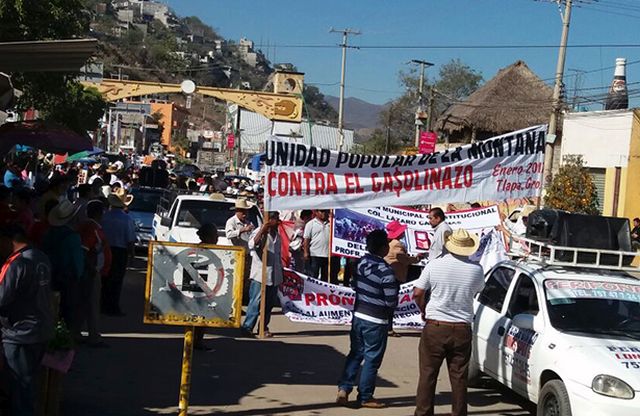
The year 2017 did not begin well for the Mexican people. The federal government of Mexico, confronting a weakening currency and rising inflation, removed fuel subsidies. The price of gasoline spiked upward by as much as twenty percent. The term gasolinazo (referring to the steep price hike of gasoline) became a part of the jargon for almost everyone in Mexico. On February 4, another price adjustment will be made; most experts suggest that this will add another eight percent to the price of gasoline.
One of the many demonstrations in Tlapa against the gasolinazo
Of course, this increase in the price of gasoline meant an almost-immediate increase in the price of transportation. And the fear is that this will lead to an increase in the prices of food and almost any other commercial good that must be transported in the country. People are angered by this change in government policy, and huge demonstrations have resulted. Tlapa has not been an exception. The gasolinazo will affect especially the poorest of the poor.
Abel Barrera, director of Tlachinollan, addresses the crowd after a march against the gasolinazo
The president of the country went on national television to justify this price increase. Among other things he said, “What would you have done?” Both pundits and experts were quick to respond. Cut the huge bonuses and extravagant salaries that high-level government officials receive, said some. Reduce the luxury travel that the president and his family are famous for, suggested others. Get rid of the new presidential plane (the most expensive in the world) was another thought expressed. Recover the money embezzled by so many Mexican politicians, opined others.
Surely Concepcion would like to see some of that embezzled money
And now there is the “feud” between Mexico and President Trump of the United States in terms of the latter’s desire that Mexico pay for a wall that he plans to build to safeguard the United States against illegal immigration. It’s too early to know just how that will be played out, but it doesn’t bode well for the economy (and people) of Mexico.
President Trump doesn't have to worry about Concepcion running across the border
Meanwhile, the daily struggle for life goes on in the mountain. Life will undoubtedly become more difficult this year, but there are many signs of life. The Marist Brothers, who coordinate the Champagnat High School of the Mountain, located in Potoichan, celebrated the 200th anniversary of the founding of their congregation. This school offers quality education and hope to hundreds of indigenous students each year. Congratulations to Brothers Cepillo, Checo, and Guicho for the great job they do coordinating fourteen teachers and 250 students this year.
Celebrating 200 years of service to the education of the poor by the Marist Brothers
And in the indigenous villages new authorities were chosen to offer their services during the year of 2017. These authorities receive no pay; they really are “servant leaders.” And accepting to give that service can present a real challenge to some of the authorities. For example, a father I know had to give up his job in another state to come back to offer service for one year in his community of Santa Anita. Now he has no fixed income—but he has two daughters studying in two different universities. Ouch!
Don Antonio, the xeñá (elder) of Xochitepec, blessing the new authorities
And next week a brigade of twenty-four dental personnel from Mexico City will come to the mountain for several days to offer free dental care in many impoverished villages. Mission Mexico will help to provide logistical support (transportation) for this project. The people are always appreciative of this hands-on kind of sharing with them.
Some of the dental personnel who will come to the Mountain next week
So we will hope for the best, and we continue working to transform life here. The most beautiful part of this effort is that Mission Mexico never works alone; there are always other persons and groups working in solidarity with the poor, and that community nourishes all involved. Thank you to the people in the Diocese of Calgary and elsewhere who support Mission Mexico. Many churches have envelopes in their pews that have “Mission Mexico” typed on them; please consider an offering for the people here. God bless, and have a wonderful weekend.
Braulio is now a lively and healthy little boy, after medical care in Tlapa
Thanks, western Canada, for allowing me to enjoy your cold and snow
during the Christmas break...yes, it was nice to get back to Mexico hee hee

Thursday, December 8, 2016

"It Is Grace Merely to Have the Chance to Serve"

This is the essence of the spiritual path of devotional service. One enters into the helping act not only because there is a need to be met. Service gradually becomes an offering, first to those we are with, but eventually to that greater truth or source of being in which we are all joined in love. Helping becomes an act of reverence, worship, gratitude. It is grace merely to have the chance to serve.
-       Ram Dass and Paul Gorman, How Can I Help?

“It is grace merely to have the chance to serve.” Mission Mexico has been experiencing that grace for many years, and as 2016 draws to a close, a lot of “special graces” seemed to come together.
This is Monica, who has never owned a pair of shoes...hopefully that will change in 2017
I visited Flora the other day in her village of Agua Tordillo. After living forty-one years seeing only “shadows” (in Flora’s words) or only “silhouettes” (in the doctor’s words), Flora can now see clearly, thanks to the MAS Clinic and Mission Mexico. What most impacted me about visiting with Flora (besides the evident joy she now experiences) was the new “cleanliness” in her life. Her clothes were clean; her house was clean; her kids were clean; the yard around her house was clean. Flora is a new woman!
To call Flora "radiant" now that she can see is no exaggeration
I visited with Braulio, who also received medical care at the MAS Clinic thanks to Mission Mexico. The liveliness in Braulio’s eyes and the energy he displays witness to the fact that this malnourished child is well on the road to recovery. He has left his village only once in his life, but he says he wants to leave again. When I asked him why, he responded with one word: “Chicken.” So I guess he enjoyed his one and only visit to a restaurant.
Braulio is one happy camper after receiving medical care
I visited a junior high school in the isolated village of Calpanapa Viejo (two hours on pavement, four hours on dirt road). They don’t have official “teachers,” but two high school graduates (Marcos and Jorge) are helping them learn. When I asked the twenty-six students if there was anything they needed, almost all responded, “Notebooks.” Hopefully Mission Mexico will be able to fulfill that wish for them early in 2017.
The junior high students and their two "teachers" in their "classroom" in Calpanapa Viejo
I visited the Champagnat High School of the Mountain, where 249 indigenous students from impoverished families in more than 35 villages where there is no high school are presently studying. The motto of the school, directed by the Marist Brothers, is “To Live Is to Serve.” The most common word one hears in the mouth of these students is “dream”: they all have the dream of educating themselves to be of service to their families and their communities. Mission Mexico helped to build the school in 2004, and it continues to support the maintenance of the school.
This year's group of students and teachers at the Champagnat High School of the Mountain: thank you, Mission Mexico
And on Sunday, the people of Tlapa were pleased that Edgar Peralta Silva came from Mexico City to share in the Sunday Eucharist with his friends at the local cathedral. Twenty-three-year-old Edgar suffered a bad fall in late April, and he is still paralyzed from the waist down. Doctors at the National Rehabilitation Institute have scheduled surgery on his spinal column for December 15. Mission Mexico wishes Edgar all the best in this delicate operation. Edgar says that he is "anxious but not scared."
Edgar at the Cathedral of Tlapa; surgery is scheduled for December 15 (hint: prayers)
I could go on and on about the “helping acts” that Mission Mexico is involved in here in the mountains of Mexico, but I hope that these examples are enough to let the reader know that Mission Mexico is making a difference in very many lives. I write this on Friday, December 9; in the Diocese of Calgary a collection will be taking place in churches this coming weekend for Mission Mexico. I know that times are challenging in Alberta, but I hope that people will be generous and that they can identify with the words included at the beginning of this note: Service gradually becomes an offering, first to those we are with, but eventually to that greater truth or source of being in which we are all joined in love. Helping becomes an act of reverence, worship, gratitude. It is grace merely to have the chance to serve. Thank you for your solidarity.
Thousands of people from hundreds of villages in the mountains will be doing a relay run this
 weekend with a torch lit at the Shrine of Guadalupe in Mexico City (I will be one of those thousands)

Tuesday, November 15, 2016

Beauty Given Back...to Flora

Deliver it, early now, long before death,
         give beauty back, beauty, beauty, beauty, 
                   back to God, beauty’s self and beauty’s giver.
-       Gerard Manley Hopkins, The Golden Echo
Flora will now be able to enjoy her early-morning sunrises
“Give beauty back…long before death.” I thought of that line as I drove Flora back to her village of Agua Tordillo. For forty-one years Flora had not seen beauty. From the time she was born, all she had seen were shadows; she had never even seen the mountains that surrounded her all of her life.
Flora being led to the operating room in the MAS Clinic
But on November 10 Flora had an operation in the MAS Clinic in Tlapa. A group of specialists from Mexico City comes to the MAS Clinic each November for four days of eye operations, and this year Mission Mexico arranged that Flora be one of the recipients of these operations. The doctors say that the operation was a great success.
Flora with her husband, Regino, and with Dr. Jorge Castro, founder of MAS
Afterwards, during the five-hour drive back to her village, Flora was full of questions. “Is that a mountain?” she asked about a big hill. “Are the mountains always this beautiful?” “Is the sky always this beautiful?” As we rounded a curve and Agua Tordillo came into sight, she asked “Is that my village?” Hearing that it was, she added, “It is even more beautiful than I had imagined.” No wonder I thought of Hopkin’s lines about beauty.
Flora and Regino at home with four of their six children
I confess that we almost didn’t make it to Tlapa for the operation. The night before leaving Agua Tordillo, it rained all night, and sections of the road became pure mud. It was a battle on at least two occasions, even with four-wheel drive, to make it uphill. But a lot of spinning (and several attempts) eventually got us through.
I think the tires give an idea of how parts of the road were in the early morning
On Saturday I will bring Flora back to Tlapa for a follow-up consultation. I am hopeful that a neighboring family will allow their son Braulio to come for a checkup. Now that Braulio’s family can see that medical care can make a difference, maybe they will be willing to let Braulio leave the village for the first time in his life. It is evident from Braulio’s eyes that he has some kind of illness.
I am hopeful that Braulio can have some medical tests in Tlapa
This beautiful gift of sight was a wonderful follow up to the Mexican celebration of the Day of the Dead just a week earlier. I was privileged to accompany villagers in their homes and in their cemeteries. I placed candles and flowers for my deceased parents in several places, but it was the night ceremony in Tototepec that was special for me. Since I was a visitor with no personal tomb, I was instructed to leave my candles and flowers below the huge cross in the middle of the cemetery.
The cross in the center of the cemetery in Tototepec
Thanks to all the supporters of Mission Mexico who helped Flora recover her sight and who help so many others in their struggle to transform lives here in the mountains. This coming year of 2017 will undoubtedly be a challenging one (not least because of the new government in the USA), and Mission Mexico will continue to do what it can to partner with the impoverished indigenous peoples in their efforts for life, dignity, and justice. God bless you for being in solidarity with these efforts.
A friend sent to me a photo taken as I placed flowers and candles for my deceased parents

Tuesday, October 18, 2016

Missioning —A Two-Way Street

From the perspective of [LaCugna’s] relational ontology, mission is just as much a conversion of ourselves as it is an outreach to others. It is not the bringing of an imperial and comprehensive truth to people devoid of truth, but rather a turning-toward-another, being-for and receiving-from another in which truth is manifest precisely in this encounter and mutual transformation. Mission, in this sense, can reach the “other” only to the degree that it also changes the missionary.
-       From an article called “Catherine Mowry LaCugna’s Contribution to Trinitarian Theology,” by Elizabeth T. Groppe, in Theological Studies, no. 63 (2002)
A family from Tlapa gave me some clothes and toys to bring to Agua Tordillo. I daresay
 that this was one of the happiest days of his life for Braulio.
It could have been worse. I had left Tlapa at 4:30 in the morning to drive to Agua Tordillo, to tell two women (Flora and Rosalia) that I had made an appointment for them with an ophthalmologist for October 25. Flora probably has cataracts; sparks from an open fire on her dirt floor burnt Rosalia’s eyes five years ago. This will be their first visit to a medical clinic. Yes, a telephone would have been better than a four-hour drive, but there are no telephones in Agua Tordillo. I arrived a little before 9 AM, spent all morning there, and left at about 1 PM to return to Tlapa.
Flora and her son Cris Angel. Flora can see nothing in the bright light outside.
I was really tired, and I noticed that my eyes were closing on their own (which isn't a great thing to happen on these mountain roads), so I looked for a shady spot on the side of the road to sleep for thirty minutes. Eventually I came across such a spot; I parked the truck, turned off the motor, and promptly fell asleep.
Rosalia and her son Manuel. Sparks burned Rosalia's eyes five years ago,
and her eyes have been  painful for her ever since.
An hour later (4 PM), I awoke and started the truck to continue my journey. That is, I tried to start the truck…but it just wouldn’t start. It was evident that the motor wasn’t getting gasoline. The clouds overhead were very dark, so I knew it was going to rain soon. I figured that it was going to be a long night sleeping in the truck on the side of the road.
The families in Agua Tordillo gave me this bright yellow bag as a gift. I love it...
Then the most amazing thing happened. Don Dagoberto, the bishop of Tlapa, passed by on his way home from a pastoral visit to Teocuitlapa. His driver, Pascual, recognized my truck and pulled over to see if I needed help. Yes, I did—so they towed me for about thirty minutes to Ayotoxtla, where there was a mechanic’s shop. I left the truck there and continued to Tlapa with Pascual and the bishop.
Don Jose—one of the kindest and wisest men I know in the mountains.
The mechanic, Victor, told me that he had in his shop a gas pump for the truck and that the truck would be ready “by Monday or Tuesday.” There is no telephone there either. I have commitments on Wednesday, so I guess that I will gamble and go to Ayotoxtla tomorrow (Tuesday) via public transport (that is, on the back of a truck, for about three hours). Hopefully I will find the Mission Mexico truck ready to go. But it won’t be a huge surprise if Victor hasn’t even started repairs. Such is life in the mountains of Mexico.
Flowers and candles—a vital part of prayer for the people in Agua Tordillo
On Friday I will drive again for four hours to Agua Tordillo, stay there overnight (I can choose: sleep on someone's dirt floor or sleep in the truck), and leave at 4 AM for Tlapa…with Flora, Rosalia, and Odilon (Rosalia’s husband). Neither Flora nor Rosalia has ever travelled to Tlapa, so I have a supply of small plastic bags ready for vomit. Hopefully we will be in Tlapa at 8 or 8:30: we will go to the MAS Medical Clinic for the appointment with the ophthalmologist. In the afternoon, we will have lunch and then return to Agua Tordillo. If I have the energy, I will return to Tlapa that night; if not, I will return on Sunday morning.
Odilon (in blue) translating from Spanish to Mephaa (the native language) for Father Vicente
On the one hand, it seems like a lot of time and energy spent for just two persons—especially since this may be the first of several visits, if the ophthalmologist suggests an operation or something similar. But on the other hand, this health care may change the lives of Flora and Rosalia—and that in turn will impact their families and their community. The villagers are already appreciative that Mission Mexico is trying to make a difference, and even this small sign of solidarity nourishes hope for all.
Going for water—a daily task
Thanks to all in Canada who support Mission Mexico. Every day life is being transformed in small and in big ways for many impoverished people. The gratitude of the people here is tangible—and it makes being here with them the greatest blessing that I can even imagine. As LaCugna suggests in the opening quote, “it changes the missionary.” Things don’t always work out, but accompanying the people in the bad times as well as the good times is what true friendship is all about. 
Being received in Agua Tordillo with necklaces of flowers—just one tangible sign of gratitude